

Navigating Family Gatherings Successfully with Nonviolent Communication
by Alan Rafael Seid, CNVC Certified Trainer
Family gatherings over the holidays are notorious for being challenging — perhaps not for everybody, but for many people.
This article walks you through some important foundational basics of this process known as Nonviolent Communication, or NVC, and offers you some practical tips for how to successfully navigate your next get-together with family.
What is Nonviolent Communication (NVC)?
Nonviolent Communication is a process for creating the quality of connection out of which people enjoy contributing to one another’s well-being.
When the quality of connection is high, this happens naturally and spontaneously. On the other hand, when quality of connection is low, we second-guess each other’s intentions, and the ground is fertile for misunderstandings, miscommunications, and conflict.
NVC is premised on the understanding that we all have the same core human motivators, also known as universal human needs.
For any set of needs, there could be multiple strategies people use to try to meet those needs.
Take safety, for example: One strategy for safety could be to remind myself to have situational awareness wherever I go. Another strategy is to be open and friendly with everyone that crosses my path. Another strategy would be to carry a gun everywhere I go. The need is the same! The strategies: totally different.
The same is true with belonging, love, creative expression, meaning, choice, and all the other universal human needs. For any need, there may be multiple possibilities for how to meet that need!
And it turns out that conflicts happen at the level of strategies, not needs.
So, when you can distill a conflict down to the universal human needs on both sides, it is much more likely for people to connect with each other’s humanity and to be able to work toward finding a mutually agreeable resolution that includes everybody’s needs.
I have been studying NVC for over 30 years, and have come to think of NVC as primarily a consciousness practice, that also comes with a framework and “tools” with which you can become more skilled over time.
The core intention of NVC is to connect — to create the kind of mutual understanding that would allow us to find a win-win.
The framework — the NVC Model — includes four components: observations, feelings, needs, and requests. These four components are very useful in three different areas where we can put our attention in the service of connection: self-connection, honest self-expression, and empathic listening.
That said, if you use language that sounds like NVC, but forget the intention to connect so we can create mutually beneficial outcomes, then it will not be NVC at all! The intention is really key!
Developing your NVC skills
NVC is typically taught in a workshop or classroom setting — and there are many options, online and offline.
You can learn more about the basics of NVC, here.
This book is a classic text for learning the principles and concepts of Nonviolent Communication.
Because having a tool and being skillful with a tool are different, I recommend building your NVC skills through online or in-person workshops and attending a practice group.
Besides workshops and a practice group, if you want to go deep, I highly recommend attending an International Intensive Training (IIT) put on by the Center for Nonviolent Communication (CNVC). At an IIT you live immersed for about nine days with a group of people sharing the intention to learn NVC — which is one of the most effective ways to deepen your understanding and skills.
The pattern with family
I have been studying NVC since 1995, primarily with its creator, Marshall Rosenberg, as well as with many other trainers he trained — and I’ve been a Certified Trainer since 2003.
In all those years the pattern has remained constant: our closest relationships tend to be the most challenging ones! Your parents, your siblings, your children, your spouse — these all tend to be the most difficult relationships!
This is for multiple reasons, including that we are more invested emotionally, there are greater expectations, and sometimes we have limiting and painful stories about ourselves and each other.
One of my teachers said, “if you want to see how enlightened you are, go spend two weeks with your parents.”
In 1999, at an IIT (International Intensive Training), I met a woman from South Africa. During this time apartheid was still in full force. Her plan? She was going to go back to South Africa, establish an interracial church, and heal all of South Africa’s racial ills. After that, she said, she might be ready to work on the relationship with her father!
Key insight for getting heard in the way you want
There’s an image I use in my workshops, and I honestly forget where I first heard it; it may have been from Marshall Rosenberg himself, or perhaps another trainer.
The image is called “the tube of communication.”

Imagine a cardboard tube — the kind people use for storing posters — or a clear plastic tube, and two people are having a conversation through the tube.
One person really wants to get their point across, so they push their scarf through the tube. But the other person also wants to get their point across at the same time — so they push their scarf to get it through the tube.
What happens?
The tube is clogged, and no one gets heard!
One thing NVC has taught me is that I can take out my scarf and momentarily place it on the shelf: I am not denying my truth, nor am I suppressing anything. I’m simply taking it out momentarily so that the other person’s scarves can make it through.
As the other person’s scarves make it through, I can check with them to make sure I’m understanding: “Is this a green one?” “Is this a checkered one?”
Once the other person feels heard, two things happen: (1) they usually stop talking, and (2) the tube is now clear.
Now that the other person feels heard, they have space to hear me.
With the tube clear, now I can take my scarf off the shelf and put it back through the tube.
The concept is extremely simple, and it’s something we all learned in kindergarten: it’s called taking turns!
And taking turns is extremely hard to do if emotions are strong and both people feel urgency to get heard at the same time!
Here is the essential insight:
The other person is more likely to hear you out if they feel heard first!
Key Insight for Preventing Resentment
The opposite of NVC could be called “violent communication” — but in NVC we also have a more descriptive term for it: Life-Disconnected, Life-Alienated Thinking and Language.
This type of thinking and language is not “bad” and it is not “wrong” — it is simply the type of thinking and language that is least likely to get you the quality of connectedness that leads to mutually satisfying results. And it is also a habit inherited from the culture and often from our family too.
This type of thinking and language consists of:
- judgments, criticism, name-calling,
- telling others what they are thinking, feeling, or intending,
- denying responsibility for our feelings, intentions, words, and actions,
- placing demands on others rather than making requests,
- justifying reward and punishment for those we judge as good or bad who therefore “deserve” reward or punishment,
- a whole series of life-disconnected motivations that damage relationships whenever we or others act from those energies or motivations (I detail these in the next section).
The issue with life-disconnected motivations is that when you or I act from them it is likely to generate resentment and disconnection.
Life-Disconnected Motivations
These include:
- fear
- guilt
- shame
- duty or obligation
- to get a reward
- to avoid punishment
- stories that include “should” or “have-to”
Any time you do anything for me out of these energies it is likely to breed resentment and therefore it is going to damage the relationship.
If you have me associated with trying to motivate you out of fear, fear, fear, shame, shame, shame — then it is very likely that in the long run my needs will matter to you less.
Here is the key insight:
The energy with which we do anything for each other is just as important as the action itself!
How to prepare for a family gathering
Here are some steps you can take to prepare for getting together with family members you find challenging.
Get empathy ahead of time!
Empathy is defined as a compassionate understanding or a respectful understanding.
When you feel heard or gotten, your nervous system becomes more regulated.
Empathy also functions as a pressure-release valve: when I have a lot of feelings, empathy gives me some relief. The pressure inside is less.
So how do you do this? We’ll look at two ways: self-empathy and empathy from others.
One way is self-empathy
In my experience self-empathy only goes so far — and yet it is essential!
Self-empathy is a vitally important self-care strategy in my life. In most situations I don’t have someone to turn to in the moment who will say “yeah, you really wanted safety and consideration!” after someone cuts me off in traffic. But I can do that for myself! (Feelings and needs vocabulary helps, and practice helps — both of which you get when you decide to learn and integrate NVC.)
As I have practiced my self-empathy skills I have been able to self-connect faster and faster in increasingly charged situations.
Before a family gathering is usually less charged than when you are there — so it is a perfect time to translate your stories into observations, feelings, needs, and requests.
So, “Ugh, uncle Joe is so annoying!” becomes, “when uncle Joe has had a couple of drinks and starts talking about politics, I feel irritated because I’m longing for ease as well as connection with others. [Pause to experience what ease and connection with others could feel like.] One request I have of myself is to talk to cousin Betty ahead of time and ask her if she would go into the kitchen with me to talk about something else if and when uncle Joe does that.”
This is a hypothetical example — and yet it illustrates several things: (1) translating a judgment into feelings and needs generates clarity and groundedness, (2) by preparing this way I’m more likely to remember where to put my attention (on my own feelings, needs, and requests) when the triggering thing happens, and (3) I can enter the situation less charged, and ready with a plan of action, which also reduces my anxiety.
Self-empathy can happen with feelings and needs cards, reviewing feelings and needs inventories, you can do it out loud, or it could happen through journaling.
The point is connecting with your own feelings, values, needs, and potential requests.
There is not one right way! In a similar situation, someone else might decide to engage with uncle Joe, with curiosity and care.
Your potential requests and strategies emerge from the connection you have with your own needs.
Empathy from others
Receiving empathy from another can also look many ways! It could happen over the phone or a video call, or meeting in person.
Technically, we don’t give or receive empathy. Instead, the listener is giving their full presence and as a result the other person’s need for empathy is met. Sometimes reflecting back what is understood can bring a lot of relief, closing the loop to confirm that understanding has actually taken place. But mainly what we are giving is empathic presence.
When I receive high-quality empathy, the other person is not buying into my story! Instead, they are listening to what is important to me at a deeper level. If I say, “she didn’t even call me!” — my empathy partner might reflect back an empathic guess, “Are you feeling sadness and disappointment because you were hoping for more connection?”
This question connects me more with the life inside me — a yearning for connection — and de-emphasizes what the other person said or did — because blaming another is an old habit that doesn’t really help create closeness or intimacy.
So when someone receives empathy they come away more connected to their feelings and needs, clearer about their potential requests, and with a lowered emotional charge!
If the people in your life are not trained in empathy, you can still gently coach them: “Hey friend, the way you could most support me is to just be present with me for about 10 minutes. At the end of that I may ask you to tell me back what you are hearing is important to me. Could you do that?”
Setting an intention for this time with family
In addition to empathy, a very valuable way to prepare for a family gathering is to set an intention.
How do you want to connect?
What will you do if you get triggered?
How will you take care of yourself, in a way that is in harmony with the needs of others?
Clarifying this ahead of time meets my needs for ease and effectiveness, because once I am in the family gathering space there is usually too much happening, in a distracting way, for me to set an intention at that point.
If I set my intention ahead of time, it is easier for me to remember what my intention was — and where to put my attention — when I need it.
Elements of NVC Practice you can bring to your family gathering
NVC has these two dimensions: the consciousness and the framework.
Please remember that the framework and the tools without the consciousness will not be NVC!
If you forget the consciousness and the core intention — to connect so that we can both get our needs met — then the tools alone become “weaponized NVC,” a form of manipulation likely to backfire.
If you can remember that the purpose and the intention is to really connect, only then will the tools serve the intention well.
When I’m triggered, it can be easy to lose sight of the intention. That’s when I go to self-empathy or empathy from another, so that I can come back to the core intention: connection.
If you can be rooted in the intention, then the tools can really serve you.
With that caveat, here are some tools, techniques, tactics that you can use in service of connection during your next family gathering:
Connecting requests
In NVC we express requests rather than demands, and generally speaking, we have two kinds of requests: (1) action or strategy requests, and (2) connecting requests.
Action or strategy requests point to an action: “Do you mind shutting the door right now?” “Could you bring me a glass of water?”
Connecting requests, on the other hand, are requests that specifically serve the conversation, the connection, the relationship. Connecting requests are one of the keys to getting through a difficult conversation.
In general, we have two kinds of connecting requests: those that request empathy or understanding, and those that request the other person’s honesty.
Connecting request #1: Requesting understanding — asking for the other person to tell us back what they’ve heard
Why would you ask another person to tell you back what they understood?
“I understand”
Most of us have had somebody say to us, “I understand” — but we don’t fully trust whether or not the person has understood.
In NVC, rather than say “I understand,” I demonstrate understanding by telling the person what it is that I have understood.
So if I’m not sure if I’m being heard in the way I want, I can ask the other person to let me know what they understood.
Because of people’s tendency to hear this as a test of some sort, sometimes I’ll phrase it this way: “could you let me know what you heard me say so that I know that I expressed it as clearly as I wanted to?” The phrasing does not have to be exact. Any variation that lets the person know that this is not a judgment of them as being a bad listener.
This connecting request helps to confirm understanding.
The sudden fight
I have asked hundreds of people in my workshops, and almost everyone has had some version of the following experience:
You are spending time with a friend or family member, everything is going fine… and 15 or 20 minutes later you are in a disagreement or a fight, and you are asking yourself how did we get here?
There is a high probability that at some point in the conversation somebody said “red” and the other person heard “blue” — and nobody noticed.
That means that from that point forward, each person is in a different conversation. They are not having a conversation together!
Each minute that goes by with this misunderstanding going undetected, takes these people farther and farther apart, and can quickly turn into a full conflict.
I had two very close friends, a couple… and we were all part of a lovely friends’ group. One day, she says to him “I don’t want to be so wifey.” He interprets this to mean “I don’t want to be your wife anymore.” He feels a sense of shock and surprise, and lashes out at her. She feels deeply hurt and pushes back. The whole thing escalates, and eventually they get divorced.
What she meant: I don’t want to be so wife-like in the sense of doing all the housework. I would like for us to share more in the housework.
Early in the conflict I offered my services but they didn’t take me up on it. The divorce ended up being so painful for him that he moved to a different city in a different state. It had a big impact on the whole friends’ group.
I wonder what would’ve happened if they had slowed down the conversation to use connecting requests. My prediction is that they would have heard each other more clearly, and that would have been a healthy start.
How do you do this?
There are many ways to do this first connecting request! People are not used to it, so the hardest part for me was getting over the awkwardness. Now, I use it any time I’m wondering if I was heard in the way I want!
Could you tell me back what you heard me say?
Could you tell me back what you’re hearing is important to me?
Would you be willing to tell me back what you’re understanding?
Are you picking up what I’m putting down? Could you tell it to me?
The important part is not following a script. The important part is the intention to connect!
Connecting request #2: Requesting honesty — asking for the other person to reveal what is alive in them in this moment
Why would you do this?
Sometimes people don’t share unless they are invited or asked.
Sometimes people don’t assume that you’re interested or want to know.
In some cases, it might not occur to them to share in that moment.
If you want to know, please don’t expect the other person to read your mind — ask!
How do you do this?
There are many ways to do it!
Now that I shared that, how do you feel about it?
What’s going on for you right now?
I’d like to know your perspective on this topic!
Your thoughts?
The important part is not following a script. The important part is the intention to connect!
The flip-side: you can offer this to the other person without waiting for the other person to ask you first!
Below are two examples of the first connecting request, requesting understanding, and then from the second one, requesting honesty.
What I’m hearing you say is ______…., am I understanding?
Can I tell you back what I’m understanding to make sure that I got it?
I have a different perspective on that, if you’re open to hearing it.
I’d like to respond when you’re done. Is this a good time?
You can offer a reflection (like a mirror, reflecting back what you understood) or your honesty — without being prompted.
With these tools, you can proactively move the conversation toward greater connection.
Listening for the needs
Marshall Rosenberg taught me that every judgment is an expression of an unmet need.
When people express themselves using static language, justifying violence, or saying things we find painful, there’s a high likelihood of an unmet need at a deeper level that is not being expressed.
In order to listen for the needs it’s very helpful to have developed some needs vocabulary to be able to identify the needs.
When you listen for feelings and needs you are forming a hypothesis… an educated guess. There may be a likelihood that your guess is correct, and NVC teaches that you can then check it out with the other person.
IMPORTANT: Remember that giving someone the sense that you understand where they’re coming from does not mean that you agree with their point of view!
In this place where our understanding of each other overlaps — mutual understanding — is where magical things can begin to happen.
When you’ve been in this work as long as I have, you also begin to see patterns.
For example:
If a family member says:
If you’re poor, that’s your own damn fault!
I wonder if they’re feeling irritation coming from a value around self-responsibility.
If a family member says:
We need to get rid of immigrants!
I wonder if they’re feeling scared coming from a need for economic security.
If a family member says:
My religion is the only true religion!
I wonder if they’re feeling concerned coming from a value around serving their family.
If a family member says:
Your husband is a good-for-nothing!
I wonder if they’re feeling worried coming from needs around trust and safety.
Wondering about their feelings and needs does not in any way mean that I agree with their position or that I condone genuinely harmful behaviors.
That empathic guess is just a start!
Remember the expression from earlier: the other person is more likely to hear you out if they feel heard first!
Here is a resource for you: a handout with feelings and needs inventories, so that you can begin to build a more robust vocabulary for feelings and needs.
Speaking from the heart
When I want to express something, and at the same time minimize the possibilities for disconnection, I will sometimes say things like:
One thing I noticed…
One thing that’s been helpful for me is…
“When that politician said that thing, what I noticed inside me was that I felt really uncomfortable because I value treating people with dignity and respect.”
This is just the beginning, but it works in groups of strangers as well as family.
The real trick is something that sounds scary: vulnerability.
Vulnerability was named correctly, because it does feel scary! I’m going to expose my heart and I could get some backlash I’m not expecting and will not enjoy.
And yet — vulnerability is what leads to true intimacy. If we don’t tell each other what we actually think, what we actually feel, what we’re actually needing and wanting … then, to what extent can it be said that we actually know each other? How much of a relationship is it, really?
When I speak from vulnerability — from my heart, my feelings and needs, rather than the thoughts I have in my head which can come across as judgmental or blame-y — I have found that it usually invites the other person’s natural humanity, vulnerability, and compassion.
And, of course, there is a whole range of how vulnerable, with whom, and at what time. I am almost not vulnerable at all with the cashier at the store, and choose deeper vulnerability with my children or my partner.
Speaking from the heart moves others and is more likely to lead to the kind of connection out of which we will both choose a mutually agreeable outcome.
Putting it all together: the NVC Tree of Life.
NVC points out three areas where we can put our attention in the service of connection.
These three areas are self-connection, honest self-expression, and empathic listening.
Each of these three areas is an entire “toolbox” and has skills you can improve in.
One way to know that you are truly improving in your NVC skills, is when you can move fluidly between these three areas, as needed.
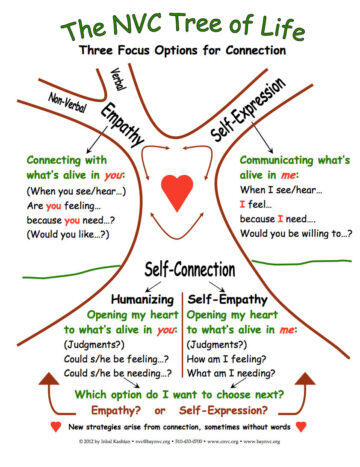
The above graphic of the “NVC Tree of Life” was created by my late colleague Inbal Kashtan.
Keep in mind that there is no should in NVC! Nobody is saying that you should open up to someone who has hurt you in the past, or with whom you would rather not interact.
Sometimes — and especially if the space is a bit contentious and not entirely emotionally safe — I will choose to be more quiet and stay mostly in self-empathy, and this is the thing that I can think of in those moments that meets the most needs!
What tactics and strategies you use will come from your self-connection. So start there!
When things don’t go how you want
Nothing in NVC guarantees that 100% of your needs will be met 100% of the time!
In fact, so much of life consists of things we want not happening, and things happening that we don’t want!
And family disconnection can be particularly painful.
So, what to do?
In some situations what we are left with is mourning.
This section addresses life-connected grieving and mourning, but first we’ll look at some of the limitations of NVC.
NVC’s limitations
I have studied hundreds of modalities, and they all have their gifts and their limitations. NVC is no exception.
Access – physical, mental, or emotional
One of the limitations of NVC is access.
If two people are in a fist fight, or if two groups are shooting at each other, you don’t have access to the kind of dialogue that would lead to a mutually satisfying outcome.
Some people are emotionally unavailable because of fear, past hurts, or unresolved trauma. In some cases, someone might be unavailable physically, and literally unreachable.
And someone may be unavailable mentally, and this could look many different ways, from cognitive impairment, to being whacked out on drugs, or because they are unwilling to engage in good faith.
Skill level
One of the most common limitations I see is skill level.
To be clear, this is not a limitation within NVC itself as a process. The fact that it can take time to master could be seen as a limitation, but skill level is primarily a limitation of the practitioner.
The higher your skill level the more effective your interventions.
The higher your skill level the more confidence you have in handling a wide variety of relationships and situations.
And in order to get your skill level where you might want it, there are three things you need:
Three ingredients for fluency in NVC
1) Interior clarity
This implies being able to access what you are feeling, needing, and wanting, in any given moment. It also entails being aware if you are running a story, have an interpretation, or are making an assumption.
If you are not clear what is happening inside, how could you possibly tell somebody else in a way that they can connect?
2) A community of support
This is essential if you want to progress in your NVC practice — and it can look many different ways: empathy buddies, an NVC practice group, or an empathy-honesty circle.
We all have times in which it is extremely challenging to regulate our own nervous system. I, personally, have at least 20 people I can reach out to at a moment’s notice to receive empathic support — and it took me years to cultivate these relationships.
You can set an intention, right now, to develop your community of support. Perhaps the best time would’ve been 10 years ago, but the second-best time is now.
3) Practice, practice, practice
This is how you get anything to become second-nature — something you can just do without having to think about it: driving manual transmission, playing an instrument, or developing high-level NVC skills.
These are the three ingredients you need to develop fluency, ease, and mastery with Nonviolent Communication.
And there’s one more limitation:
Knowledge and imagination
Once we are connected with each other’s needs and we are looking for a solution we can both be thrilled about, or at least that we can both live with, that’s the time to explore strategies together.
The problem with strategies is that we tend to jump to them before we are connected with the underlying needs we are trying to meet — and then we wonder why those strategies didn’t work!
However, strategies are incredibly important! They are the concrete and specific ways that we try to meet needs.
And the two biggest limitations on our ability to generate strategies that contribute to needs are:
1) Our knowledge of what exists or has been tried that works.
2) Our ability to imagine new possibilities and create strategies that never existed before.
Again, these are not limitations inherent to NVC as a modality. These are limitations within you or me as practitioners in how well we can get NVC to work for us.
I will mention one more thing here that is worth noting: the answers you get depend on the questions you are asking. And sometimes the most powerful part of imagination is coming up with the questions that will point you in the direction you want to go.
Let’s look next at what NVC teaches about life-connected grieving and mourning — because sometimes that is the path forward that meets the most needs.
Life-connected mourning
In some circumstances what we are left with is mourning — so that we can process and integrate a situation, and then move forward.
Life-connected mourning consists of being present with the feelings you are experiencing while staying connected to the needs.
In the past, when my needs were not met, it would be easy for my mind to start wondering whose fault it was. I would play the “who’s-right-and-who’s-wrong” game.
In my pain, and with habit-patterns inherited from my family and the culture, I would want to go punitive: find out who is responsible and punish them. And in the insanity of that way of thinking, somehow believing that that would bring me relief, ease my pain, or bring me some healing. It was never healing, and not once did that create a satisfying resolution.
So how do you do life-connected mourning?
First, you let yourself have your experience. Sometimes we run because we don’t want to feel uncomfortable feelings.
Be with your feelings. Just have them. Get curious: where is this feeling in your body? Is it static? Is it moving? See how much you can observe it objectively. Don’t run, marinate in it.
While you are present with what you are feeling, see if you can connect with the need that the feeling is coming from.
For example, I found myself in the situation in which I felt extremely sad. And I let myself feel my sadness fully. My sadness was coming from a need for contribution. I had just tried to contribute to a situation, and in the case of at least one person, it resulted in pain and discomfort — so my need for contribution, at least in the case of this one person, was not met. As a result I felt extremely sad. But I stayed connected to the need for contribution. After some time, the sadness subsided and I was left basking in the beauty of this wonderful energy we call contribution.
Consider that grief and mourning are the other side of the coin from celebration. The reason I grieve is precisely because there is something wonderful or beautiful that I have lost.
Be present with the feelings you are experiencing while at the same time staying connected to the beautiful underlying needs.
Conclusion
Family gatherings can be hard.
Please be gentle with yourself.
And please commit to building your skills!
May each family gathering be less painful and more enjoyable than the last!
Marshall Rosenberg on family gatherings and personal responsibility
Marshall Rosenberg was the first one to point out to me that our closest relationships tend to be the most challenging ones.
That’s the pattern.
And yet, NVC is not a set of tools to get others to do what you want them to do! Nor is it a tool to control outcomes!
At a family gathering, you do your best with the skill-level you have, and you let go of the rest.
After all, you are not responsible for things you cannot control.
So what are you responsible for?
Marshall Rosenberg said that we are responsible for three things and three things only.
You are responsible for:
- your intentions,
- your words, and
- your actions.
Everything else, you cannot control — so you are not responsible for it.
PuddleDancer Press Books on NVC and Family Relationships
PuddleDancer Press is the foremost proponent and publisher of books on Nonviolent Communication and family relationships.
NVC has shown time and again that human beings are capable of connection and mutually crafted solutions.
Because of the trust-building process involved, and the fact that the solutions include everyone’s buy-in, using NVC for family relationships predictably gives you outcomes that meet a greater number of needs and are more durable.
Our books on family relationships can help you:
- Create exceptional personal and professional relationships,
- Offer compassionate understanding to others,
- Know when and how to ask for that same understanding for yourself,
- Prevent and resolve misunderstandings and conflicts,
- Speak your truth in a clear, powerful way more likely to lead to harmony than conflict,
- Create mutual understanding without coercion.
Whether you are a long-time student — or are brand new to NVC — PuddleDancer Press has the educational resources, including the books on family relationships, to help you grow your emotional intelligence, interpersonal skills, and communication prowess.
Check out our catalog of books on family relationships… and give yourself the gift of Compassionate Communication!
