



The Awakened Heart: Nonviolent Communication and Buddhism
Personal disclosure
In 1991, at the age of 20, an Outward Bound instructor offered me some one-on-one feedback:
You understand things pretty well cognitively, but I highly recommend that you get first-hand knowledge through meditation. I’m not here to sell you on my tradition or technique. Instead, you’ll need to go out there and “shop around,” excuse the expression… and you might need to sit with something for two or three years before you know whether or not it’s for you.
I took his advice to heart, and have explored five or more different meditation practices before landing on the one — rooted in Buddhism — that I felt was the best match for me.
Though I am a meditator and a student of Buddhism, I do not consider myself Buddhist. While I am an expert in Nonviolent Communication, I am a lay student of Buddhism and not a Buddhist scholar.
I wanted to share this with you, dear reader, right at the outset of this article — for transparency, and so that you know a bit more about where I’m coming from.
Intro — The Moment Everything Slowed Down
I was at a silent meditation retreat.
It was a break and I was walking outside in the grey drizzle. The path was a little muddy, the grass was green and wet.
Mostly, my attention was inside, noticing a part of me that’s very attached to other people liking me. This part yearns for people to have a certain opinion of me, for them to see me in a positive light. The way this part of me acted reminded me of a compulsion or an addiction.
My Nonviolent Communication (NVC) training kicked in. After so many years it now happened almost automatically.
What’s the need?
Well, if I want people to like me and think positively about me then the need is probably something around belonging and acceptance.
And then I noticed the thoughts: if people don’t like me, surely there must be something unlikeable about me! And when people do like me, then I’m ok with myself.
BOOM! The insight left me stunned:
Hiding underneath my desire for acceptance from others was my need for self-acceptance!
If people thought I was cool, then probably I was cool; if someone thought I was a jerk, maybe there was something wrong with me.
This revelation broke the chain linking my self-acceptance to what other people thought of me!
Now that I saw it, I could never unsee it!
(Thank you NVC, and thank you meditation!)
In the paragraphs that follow I offer a brief overview of NVC followed by a beginner-level primer on Buddhism.
Then we’ll explore the overlap of the two and how they differ from and complement each other.
What Is Nonviolent Communication — And Why “Technique” Misses the Point
I remember the workshop with Dr. Marshall Rosenberg — the originator of NVC.
On the white board he had written a heading: “The NVC Model.”
Below that, on one side he wrote “empathy” and on the other “honesty.”
And then, below both of these sub-headings he wrote a bulleted list:
- Observation
- Feeling
- Need
- Request.
I had seen this chart many times before, but what he said next really surprised me.
He turned to the group, pointed to the white board, and announced, “This is not NVC!”
Big emphasis on not.
Blank stares throughout the room.
What was he talking about? I had no idea, and I had been studying NVC for a few years. I could sense the confusion around me.
He continued: NVC is primarily the consciousness and the intentionality that you bring to your interactions!
A consciousness practice + tools
He went on to explain that no amount of “doing the model well” or “speaking NVC correctly” will amount to NVC if the intention is off.
And what is the core intention of NVC?
NVC is based on the insight that when we feel connected with each other we are much more likely to prevent and resolve misunderstandings and conflicts in a way that is mutually beneficial.
Therefore, the core intention of NVC is to create a certain quality of connectedness out which we naturally and spontaneously enjoy contributing to one another’s well-being.
If my intention is to get my way or to manipulate a specific outcome, it doesn’t matter how good I am at the “technique” side — it’ll never be NVC. It could then only amount to a subtle form of manipulation — which goes against what NVC is about.
This is when people say “NVC didn’t work” and people experience NVC being weaponized.
If someone says “NVC didn’t work” because they didn’t get the other person to do what they wanted, then they have missed the point, because that is not what NVC is for! Again, NVC is for creating a certain quality of connectedness out of which people naturally and spontaneously enjoy contributing to one another’s well-being.
If someone is using the technique side but their intention is to manipulate, then, yes, they are weaponizing NVC — and, again, it is far from what NVC is actually about.
The consciousness and the intentionality are primary — AND they also come with a framework and a set of concrete tools you can become more skillful with over time.
In my over 30 years of studying NVC, more than 20 of those as a Certified Trainer, I have seen relationships and conflicts transform, again and again, in a way that seemed miraculous or magical to those who didn’t understand. In many of those cases I was the one facilitating the breakthrough.
The tools are actually very simple — but that does not make them easy to put into practice. This is because our old acculturated habits — especially how we act when we are hurting — run very deep.
You can learn the tools and become more skilled at the technique side of NVC. But if the consciousness and intentionality is off, it will never be NVC.
If the consciousness and core intention are there, you can be clunky and unskilled with the tools — but it will be in alignment with NVC, and much more likely to get you the results you are looking for.
To be clear: NVC is about getting your needs met — AND, how to do it in a way that’s in harmony with the needs of those around you.
The Giraffe and the Jackal — Two Languages, Two States of Heart
Giraffe and Jackal are two metaphors you’ll come across in many NVC circles. Giraffe is one of the names for NVC. Jackal is what we call its counterpart: “violent communication” also known as life-alienated, life-disconnected thinking and language.
These each represent completely different orientations toward relationships, communication, and even human nature.
Jackal — life-alienated, life-disconnected thinking and language — is based on judging others, criticizing them, avoiding responsibility and blaming, rigid conceptions of good/bad, right/wrong, static thinking about who is what (especially who is bad, thereby justifying punishment), and motivating people through fear, guilt, shame… and more.
These are largely old habits, inherited down the generations, which most people use unconsciously — and yet they destroy relationships.
The metaphor of the giraffe recognizes that it is one of the land animals with the largest heart. Its height gives it a perspective that any time I meet my needs at the expense of another person’s needs, in the long run my needs are not met. Any time I create a win-lose situation, in the long run I also lose. In other words, NVC aims for a true win-win, a mutually beneficial result.
From wrongness to aliveness
When I met Dr. Marshall Rosenberg he had been traveling the world, training people and mediating conflicts, for decades.
And he had an observation I found fascinating: all over the world, in every culture, people are playing one of two games. One of those games is called “who’s right, and who’s wrong?” and the other game is called “how can I make life more wonderful?”
These “two games” directly correspond to Jackal and Giraffe.
Jackal is the mindset of focusing on who is right and who is wrong. It often follows that if someone is wrong that means they are bad and deserve to be shamed, punished, and so on.
Giraffe is the mindset focused on the question “how can I make life more wonderful?”
This is a major shift, from wrongness to aliveness.
In NVC we focus on what is alive mostly through a language of universal human needs: love, trust, safety, belonging, autonomy, and so forth. These needs are how life itself is showing up in each of us in this moment!
And we have the four components of the model — observations, feelings, needs, and requests — guiding our attention to important information that is more likely to help us get our needs met than focusing on who’s right and who’s wrong.
By focusing on clear observations (data) about what happened, feelings as indicators of something deeper, needs as the life-force impelling us to speak or act, and requests as a way of taking responsibility by asking for that which would enrich life — we are far more likely to create the quality of connection that yields the win-win outcomes for which we are looking.
In jackal, you ruin all your relationships, intentionally or unintentionally — but the payoff is that you get to be right!
In other words, life frequently offers you a choice: you can focus on being right or you can have good relationships!
Developing Your NVC Skills
NVC is typically taught in a workshop or classroom setting — and there are many options, online and offline.
You can learn more about the basics of NVC, here.
This book is a classic text for learning the concepts of Nonviolent Communication.
Having a tool and being skillful with a tool are different! I highly recommend building your NVC skills through online or in-person workshops and attending a practice group.
Besides workshops and a practice group, if you want to go deep, I highly recommend attending an International Intensive Training (IIT) put on by the Center for Nonviolent Communication (CNVC). At an IIT you live immersed for about 9 days with a group of people sharing the intention to learn NVC — which is one of the most effective ways to deepen your understanding and skills.
Buddhism — A Path of Awakening, Not a Religion
The Buddha was not “buddhist.”
Like all belief systems that give people meaning, Buddhism also has its fundamentalist adherents who practice their version of Buddhism through dogma and blind belief, accepting what somebody told them without questioning it. This happens in all the major religions, traditions, and philosophies.
The word “buddha” literally means awakened one. The man, Siddhartha Gautama, said there were countless buddhas before me, there are currently, and there will be countless buddhas after me. In other words, he did not lay claim to a monopoly on being awakened. Anyone, he asserted, can become a buddha, an enlightened person.
He wasn’t looking for a title or a cult following.
His life story tells of a prince raised in comfort and luxury. But he was also troubled by something. He saw suffering, misery, discontent, dissatisfaction, and unhappiness in the world. He wanted to help, and decided that he could not genuinely be of service unless he himself found the path for ending his own suffering first. He left the palace and the life of royalty for this search.
Siddhartha Gautama was a human being, not a deity, who investigated the nature of suffering and found a path through it.
He discovered a method that involves directed self-observation and taught that to others. It spread, as did his renown. But what was important to him was not his own fame. What mattered was that people come out of their misery.
What the Buddha taught was a methodology, an empirical path of investigation — not a belief system requiring faith.
The technique that he taught 2500 years ago, in what is now known as northern India, spread to other parts of the world. As the technique traveled, over centuries it also morphed and evolved, giving us three major schools or movements within Buddhism (Theravada, Mahayana, and Vajrayana) — and an enormous variety of schools and practices from the Tibetan Dzogchen, to Zen, to Vipassana, and many others.
In my studies, however, what I have found at the core of Buddhism is the intent to have people transform their discontent without any coercion to blindly adopt a particular belief structure.
Renowned Vipassana teacher, S.N. Goenka, framed the Buddha’s teaching (Dharma in Sanskrit) as a universal law of nature — like gravity, it operates whether or not you believe in it. Goenka was transparent and outspoken about teaching Vipassana to people of all faiths and none. (The Theravada/Vipassana tradition is particularly grounded in direct experience over doctrine.)
Christians, Muslims, Jews, atheists, agnostics — and people of all faiths and walks of life — have adopted meditation and/or mindfulness practices that originated from Buddhism without there being any requirement to convert to a particular religion, sect, or belief system.
The Eightfold Path
Buddhism is known as the eightfold path or sometimes the Noble Eightfold Path.
While it is beyond the scope of this article to delve deeply into each of these, here is a quick overview of the eight aspects of Buddhist study and practice:
Right View (or Understanding): Seeing life as it is, understanding the Four Noble Truths, impermanence, and cause and effect.
Right Resolve (or Thought): Intention to act with compassion, non-harming, and detachment.
Right Speech: Abstaining from lies, slander, harsh words, and idle chatter.
Right Action: Behaving ethically by not killing, stealing, or engaging in sexual misconduct.
Right Livelihood: Earning a living in a way that does not cause harm or suffering to others.
Right Effort: Cultivating positive states of mind and letting go of unwholesome ones.
Right Mindfulness: Developing awareness of the body, feelings, mind, and mental qualities.
Right Concentration: Developing a focused, tranquil mind through meditation.
(https://tricycle.org/magazine/noble-eightfold-path/)
The Buddha’s Diagnosis — Dukkha, Craving, and the Way Through
Everyone wants to be happy, right? It’s practically a cliché! If everyone is looking for happiness that implies that nobody has it.
Siddhartha Gautama, the man we call the Buddha, saw a situation in which people — no matter how hard they tried — could not find lasting happiness.
He used the word Dukkha which is most commonly translated as misery or suffering. However, there is a case to be made that this can sometimes be an over-translation, and that the term equally applies to dissatisfaction and discontent, apparently a chronic human condition.
The First Noble Truth translated into NVC
In Buddhism you’ll find The Four Noble Truths — which are not entirely dissimilar to a physician’s approach: diagnosis, cause, prognosis, prescription.
The First Noble Truth is the universality of misery or suffering. In other words, being discontented, unhappy, or dissatisfied is essentially a universal human condition.
In NVC terms, we can think of this as the universality of the experience of unmet needs. (After all, nothing in NVC guarantees that 100% of your needs will be met 100% of the time!)
We all experience unmet needs, regularly, perpetually!
From a Buddhist perspective, in essence, we experience unhappiness, or dukkha, when something that we don’t want happens, or something that we want doesn’t happen.
Dukkha (suffering/unsatisfactoriness) can be seen as a common starting point for both Buddhism and NVC — both begin by honestly acknowledging what is painful.
The issue is not desire itself, but rather attachment
The degree of intensity of that dissatisfaction or suffering correlates directly to how attached you are to that outcome. The greater the attachment the greater the unhappiness.
I’ve spoken to a good number of people who think Buddhism is about getting rid of desire. It’s not desire itself that’s the issue. The issue is the attachment, usually to a specific outcome, that comes along with desire.
The Needs vs Strategies differentiation from NVC as an aid in detachment
In NVC, we hold fast to our needs! We don’t self-abandon, or deny what’s alive in a way that can lead to self-harm of any kind.
But though we protect our needs, we hold the strategies lightly.
The needs are universal, therefore they don’t refer to any specific person taking any specific action.
Strategies, on the other hand, are the specific, concrete ways we attempt to meet needs.
As you deepen in NVC, you notice that for any set of needs there could be dozens or hundreds of potential strategies.
This insight — differentiating needs from strategies, along with staying connected to the needs while being flexible around the strategies — can go a long way to helping you lessen your attachment to specific outcomes.
Renowned author and teacher, Thich Nhat Hanh, taught the concept of interbeing as a way of understanding interconnection. Interbeing is a useful way of understanding universal human needs, because we all have the same needs.
Another analogy would be language. While you are reading my words, in a very real sense these are not my words at all! I didn’t invent the English language: it existed before I was born and will exist after I die. So in a very real way these are not my words. Except they are. It’s a paradox. Universal human needs are like that — they exist in a collective field in a way similar to language.
Hypothetical example: I desire lunch
For example, I desire lunch. That’s perfectly natural. Then I go into my kitchen, and my fridge is empty. If I have little attachment, then my emotional charge will be low. I can still feel my disappointment, but then I can regroup and ask myself, “what do I want to do now?” If my attachment was a 10 out of 10, then whatever I feel — anger, rage, disappointment, sadness, depression — I will feel it with great intensity. It may be an experience that leaves me depleted. Now my interior resources around “what do I want to do next?” are reduced.
Now multiply this scenario times once per day, or hundreds of times per year, and you can see how being very attached to specific outcomes, and not getting them, could be more problematic because of the way I am constantly emotionally disregulated.
Cultivating a sense of detachment from specific outcomes is foundational to Buddhism’s approach to helping you let go of your attachments. And it’s also very valuable in NVC, since, as mentioned above, any set of needs could have a hundred possible strategies to meet those needs.
This is one of the ways Buddhist practice complements NVC and vice versa.
But how to detach?
This is the key question.
Each school of Buddhism has a slightly different approach to letting go of attachment or being more detached.
For a simplified example: in the Theravadan traditions there is usually more of an emphasis on renunciation from worldly things and achieving deep insight into the nature of craving and aversion. The Mahayana schools might emphasize non-attachment along with compassion and being of service. And the Vajrayana schools might see attachment itself as a distortion of mind and attempt to transform it through a variety of practices.
But they all agree that to the degree that you are attached to a particular outcome you are inviting dissatisfaction, discontent, misery, or suffering — a situation in which your needs are unfulfilled.
As mentioned above, there is a similar dynamic within NVC — we stay connected to the life-energy of the needs while remaining flexible on the strategies. Intense attachment to a specific strategy usually leads to unfulfilled needs.
The Pragmatic Usefulness of Death
Another common thread — and a valuable way to loosen your attachments — is contemplating your own mortality as a real certainty.
There are many books in the Buddhist literature that cover death and dying. These include The Tibetan Book of the Dead, and the more modern adaptation, The Tibetan Book of Living and Dying.
The Dalai Lama has also written on making peace with your own death, including The Joy of Living and Dying in Peace, and Mind of Clear Light: Advice on Dying and Living a Better Life.
One classic Buddhist text, the Satipatthana Sutta, has an entire section dedicated to contemplating the decay of the body as a way to detach from all our attachments in this lifetime.
It is gruesome and graphic, in a way that quite normalizes your and my impermanence.
And this is a key word — impermanence! In one tradition within Vipassana, for example, you are asked to experience the impermanent nature of sensations in the body as a way to deepen detachment from the body, while also re-patterning the mind to experience and notice impermanence everywhere, thus strengthening your sense of detachment across situations.
The focus on mortality is not about having a morbid obsession with death. On the contrary, it’s to help us wake up to the preciousness of each moment. An awareness of your own finite nature — a connection with your own death — can lead to feeling less attached to specific outcomes, which leads to life becoming easier and more free.
Of course this is easier said than done! Understanding this intellectually is fairly accessible, but the only way it becomes living wisdom, it seems, is through practice.
Ascending and Descending Spirals, and Nondual Spirituality
Philosopher Ken Wilber writes that there has been a spiritual war of sorts between two different camps, which he sometimes calls the ascending currents of spirituality and the descending currents of spirituality.
The ascending currents are about transformation and transcendence. Traditions in this current emphasize the illusory nature of the world as something which in itself must be transcended so that we are no longer in the illusion.
There are versions of transcendent spirituality in all the major traditions. All of Buddhism has this aspect, though it is particularly pronounced in the earliest school, Theravadan Buddhism.
The descending currents are all about immanent spirituality: Spirit or God is here now, in everything: the spirit that moves through all things.
There are versions of immanent spirituality all over the world, including in Paganism and many of the Earth-based religions.
Transcendent spirituality, is largely about matter ascending into spirit.
Immanent spirituality is largely about spirit descending into matter.
Nondual spirituality honors both ascending and descending currents — it recognizes transcendence and immanence.
Even in Theravadan Buddhism, which is largely associated with the ascending currents of spirituality, has its own descending aspect in Mettā (or metta) — a meditation technique for sending loving-kindness and compassionate love to all beings. Though the practice of metta exists throughout Buddhism, I wanted to point out its existence in even the traditions that most emphasize transcendence.
Tibetan Dzogchen is considered by some scholars to be a true nondual tradition from the standpoint that the practices are intended to help you see through the illusion of separateness between subject and object (rather than reducing everything to “one thing”). (https://en.wikipedia.org/wiki/Dzogchen)
Though Buddhism is usually thought of only in ascendent or transcendent terms, it also has strong currents of immanent, here-now spirituality.
Another way the descending and immanent currents show up is in “socially engaged Buddhism” — a term coined by Thich Nhat Hanh to reflect a movement that applies Buddhist ethics, mindfulness, and compassion to actively alleviate social, political, economic, and environment suffering.
Where the Paths Converge — Self-Awareness and Compassion as the Ground of Being
NVC and Buddhism — both paths begin inside.
Self-knowledge and self-connection
Through self-connection, NVC helps me unwind stories and judgments. The more self-connected I am, the more I am able to share through vulnerable honesty. The less triggered I am the more present I can be through empathic listening.
The inner work of NVC provides a starting point and a solid foundation for interpersonal relating.
Both NVC and Buddhism are clear that rather than focusing on fixing others we are more resourced in our interactions if we develop deep self-understanding.
Both NVC and Buddhism recognize the same root of most human harm, though they express it in their own terms.
In NVC, most human harm comes from unmet needs expressed in a life-alienating way, whereas Buddhism might express it as unskillful action rooted in ignorance. These are different ways of describing essentially the same dynamic.
NVC emphasizes self-connection, self-awareness, self-empathy, and self-compassion — teaching you how to embrace your inner jackals and transform them by connecting to the underlying needs.
This is analogous to Pema Chödrön’s teaching of maitri, which is the cultivation of unconditional friendliness, compassion, and loving-kindness toward yourself. Maitri is the practice of making friends with yourself, embracing all aspects of your being — including faults and pain — without judgment, which then allows you to extend genuine compassion to others and feel at home in your own skin.
Key Aspects of Maitri (Unconditional Friendliness)
- Not Self-Indulgence: Maitri is not about avoiding reality, pampering yourself, or narcissism. It is a courageous commitment to be kind to yourself while facing difficult emotions, pain, and insecurities.
- “Holding Your Seat”: This involves sitting with discomfort, fear, and failure instead of running away or numbing yourself. It means being present with your experience.
- Befriending the Shadow Self: Maitri encourages stopping the cycle of self-denigration and looking at your own “ugly, mean sides” with curiosity and kindness rather than shame. This is similar to how NVC encourages us to love our jackals so that they can transform.
- Unconditional Nature: Like unconditional love, this friendliness is not contingent on feeling good, being successful, or behaving perfectly. You treat yourself with gentleness and kindness independently of other conditions or circumstances.
(https://tricycle.org/article/pema-chodron-maitri/)
Remember the anecdote I opened with, in which I discovered that underneath or behind my need for acceptance was self-acceptance? That moment of pause was simultaneously me as an NVC practitioner turning inward and me as a meditator touching the present moment.
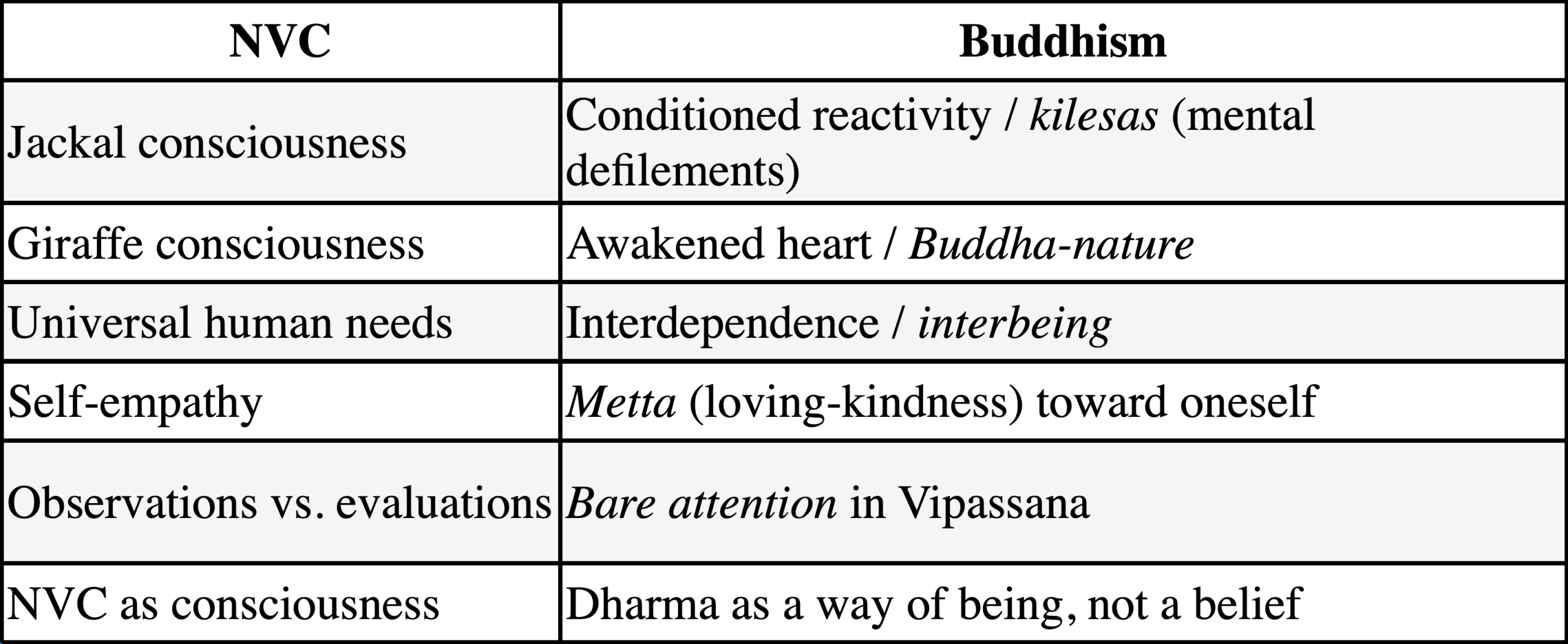
Self-Empathy as a Contemplative Practice — The Inner Work of NVC
Self-connection, including self-empathy, gives us a beautiful bridge between NVC and Buddhist inner practice.
Self-empathy is not self-pity, self-indulgence, or navel-gazing — it is the capacity to be with your own feelings and needs with the same quality of presence you might offer a beloved friend.
Self-empathy is similar to what Vipassana meditators practice: observing inner experience without judgment, without suppression, without reactivity. If reactivity happens, that becomes another object of observation with curiosity.
The Jackal voice turned inward — self-criticism, shame, “should” — is perhaps the most insidious form of violence. Both NVC and Buddhism name this clearly.
The late Robert Gonzales’ work on living compassion grounds NVC in meditative, embodied, moment-to-moment practice.
Here is an NVC invitation for you with a Buddhist twist: sit with your Jackal voices (self-judgments, inner critic, etc.) the way a meditator sits with a restless mind — with curiosity rather than resistance, aversion, or opposition. Only when you perceive these voices clearly can you work with them effectively.
Hurt people hurt people
When you are in emotional pain, what is the tendency?
If you are like most people, you lash out or withdraw.
Imagine how tragic this is!
When we most need others’ love, care, acceptance, and compassion — we tend to act in ways that make it least likely that we are going to get that love, care, acceptance, or compassion!
That is the pattern in the world around how people usually handle their pain: withdrawing or lashing out.
Violence is an expression of unmet needs. Someone whose needs are satisfied — in a state of contentment — does not hurt others.
Judgments and criticism are expressions of unmet needs.
Lashing out and hurting others are expressions of unmet needs.
Understanding the needs does not mean we condone or make excuses for the harm done.
What happens when your needs are not met is precisely the root of violence!
NVC teaches you life-connected mourning. This type of grief work is an entirely natural, healthy, and growthful way of handling pain. In life-connected mourning you are present with the feelings flowing through you while staying connected to the underlying needs (rather than to the thinking about who is right or wrong).
When you are in pain, NVC invites you to:
- Get curious about what is happening inside.
- Understand your deepest motivators. These universal human needs are what we need to thrive and what motivates us to speak or act. It’s how life is moving through you in this moment.
- Connect with your feelings, which are indicators that something is happening at a deeper level. Feelings point to the deeper needs.
- Be able to distinguish between the blame game, the who’s right and who’s wrong game — and the game of how can we all get our needs met? How can I make life more wonderful and how can we contribute to each other? Distinguishing between these two fundamentally different orientations to life and relationships is a valuable starting point. Then — consistently choose connection and win-win outcomes.
- Be able to separate needs from strategies. Understand how for any set of needs, there could be dozens of strategies. The ways people satisfy needs for safety or connection, as only two examples, could include hundreds of possibilities!
Buddhism invites you to get to know yourself at deeper levels and discover entirely new awareness about yourself and the nature of reality.
NVC gives you a set of intentions, principles, frameworks, tools, and skills to excel in your relationship with yourself and your interpersonal relationships with others.
NVC and Buddhism bring different strengths to the table — and they are complementary.
An Invitation to Simply Notice
NVC and Buddhism are not destinations. They are dynamic orientations, ways of remembering and returning again and again.
NVC and Buddhism are kindred approaches, not competing frameworks. Any sense of having to choose — or even asking which one is better — would be missing the point.
A valuable question to sit with could be: What would it mean to meet this moment — this conversation, this conflict, this silence — with an open heart?
As one of my teachers once said, the power is in the pause.
As in my opening anecdote, as with the next time you have a self-recriminating thought, or the next time someone triggers you: the pause is the beginning of the practice.
Marshall Rosenberg on Spiritual Clarity
Marshall Rosenberg used to talk about three things needed to become fluent in NVC: spiritual clarity, a community of support, and practice, practice, practice.
“Spiritual Clarity”
I pressed him on this question of spiritual clarity. After all, the word “spiritual” itself has different meanings in the English language, and for some people it carries subtle overtones or even an emotional charge.
So I pressed him on it. “What does spiritual clarity mean?” His response: clarity about how life energy is moving inside you. And the language he used to describe the Life inside any of us was a language of universal human needs.
Needs — Life itself as it moves in you and me — are the foundation of NVC spirituality.
As the conversation unfolded, we landed on interior clarity.
For me, interior clarity includes the self-awareness to be able to tell if I’m making an assumption, telling myself a story, and differentiating between what I’m observing and my evaluations about what I’m observing.
Interior clarity includes, of course, making contact with my feelings and my needs. It also includes knowing what I want, and being able to formulate a clear, present, actionable request.
For Dr. Rosenberg, clarity about the life in me and in others, and the ability to connect for the sake of mutual benefit: that constituted the spirituality of NVC.
Interior clarity equals spiritual clarity.
Know thyself!
My NVC conundrum
During a trip with Marshall Rosenberg I remember asking him a question which perplexed me:
“Marshall,” I asked, “I notice some people come to an NVC workshop, and in one or two workshops they get it. They understand, they know how to practice, and they advance quickly…
“In the meantime,” I continued, “other people take workshop after workshop — years’ worth of workshops — and they don’t seem to advance or progress in their NVC. They struggle and struggle and don’t seem to make much headway. Why do you think that is?”
His response: “I don’t know. But I can tell you one thing: people who have some kind of awareness-based practice seem to progress faster in NVC than people who don’t.”
Additional resources
A Field Guide to Right Speech: Buddhist teachers Sharon Salzberg and Oren Jay Sofer explain how to develop healthier relationships through mindfulness and Nonviolent Communication.
https://tricycle.org/article/nonviolent-communication-buddhism/
NVC & Buddhism: heart-to-heart communication
https://seedofpeace.org/nvc-buddhism-heart-to-heart-communication/
Buddhism and Nonviolent Communication
https://shambhalatimes.org/2018/10/18/buddhism-and-nonviolent-communication/
PuddleDancer Press Books on Nonviolent Communication and Personal Growth
PuddleDancer Press is the foremost proponent and publisher of books on Nonviolent Communication and personal growth and development.
NVC has shown time and again that human beings are capable of transcending and transforming conflicts, and arriving at mutually crafted solutions.
Because it requires you to be clear inside and helps you connect with others and improve your relationships, using NVC for personal growth and development predictably gives you outcomes that meet a greater number of needs and are more durable.
Our books on personal growth and development can help you:
- Create exceptional personal and professional relationships,
- Offer compassionate understanding to others,
- Know when and how to ask for that same understanding for yourself,
- Prevent and resolve misunderstandings and conflicts,
- Speak your truth in a clear, powerful way more likely to lead to harmony than conflict,
- Create mutual understanding without coercion.
Whether you are a long-time student — or are brand new to NVC — PuddleDancer Press has the educational resources, including the books on personal growth and development, to help you grow your emotional intelligence, interpersonal skills, and communication prowess.
Check out our catalog of books on personal growth and development… and give yourself the gift of Compassionate Communication!

