


Nonviolent Communication, Political Despair, and Empowered Action in a Time of Democratic Crisis
By Alan Rafael Seid, CNVC Certified Trainer
NOTE:
The content and opinions in this article come from the author only and should not be construed as the views or opinions of PuddleDancer Press.
Content warning
This article discusses authoritarianism, fascism, democratic backsliding, repression, surveillance, propaganda, civil liberties, and political violence. These topics can evoke fear, grief, anger, numbness, or hopelessness. Please go slowly. Pause as often as you need. If you notice your body tightening or your mind racing, try one of the short grounding practices woven throughout.
Introduction — What this article is (and is not)
Many people who would not call themselves “political” are waking up with a terrible weight: This is getting worse. I don’t know what to do. I feel despair.
In the US, the speed and intensity of institutional stress — norm breaking, disinformation, threats of retaliation, intimidation, selective enforcement, and a general erosion of shared reality — has pushed a lot of nervous systems past their capacity.
This article is written with the US in mind, but the intention is to offer something useful to anyone living under, or watching the rise of, authoritarian dynamics anywhere in the world. You may disagree with my choice but I’ve intentionally avoided naming specific people and specific places precisely because the situation is so fluid — and because my intention is to offer something that will be useful for the long term.
This is also not a partisan screed. In this article I name authoritarianism and fascism explicitly, but I do not center one individual by name (for practical reasons, including platform risk). This article is not a call to violence, and it is not a “just stay positive” bypass.
This article is a map for staying human, staying safe, and staying engaged — using the lens of Nonviolent Communication (NVC) and the lived reality of nonviolent social change.
If you’re reading this and thinking, “I’m overwhelmed. I need something I can actually do!” — good. That’s where we’ll be going, together, in the paragraphs ahead.
Here is a list of the sections of this article-as-map, so that you have an overview of what is below — a Table of Contents of sorts:
- What is political despair, and how is it different from depression?
- Somatic micro-practice: the 20-second “orienting” reset
- What is Nonviolent Communication (NVC)?
- Overview of NVC and social change — and its limits
- NVC is Necessary but not Sufficient
- Naming the reality: authoritarianism, fascism, and democratic backsliding
- The current political situation in the US
- Despair as a signal, not a personal failure
- Grief and mourning: the fuel we don’t talk about
- Somatic practices for overwhelm: regulating the body so the mind can think
- Community is not optional: it’s a survival skill
- Mindsets that protect your humanity in dehumanizing times
- Your biggest limitations are your knowledge and imagination
- Self-care as care for the whole
- From numbness to agency: why action heals despair
- What nonviolent social change actually looks like
- Concrete ways to contribute without burning out
- Key Differentiation in NVC: Protective Use of Force vs Punitive Use of Force
- Staying safe without becoming paranoid
- Knowing your rights: civil liberties as psychological protection
- Talking about politics without losing your soul
- Hope without denial
- Political despair as initiation, not defeat
- Reflection questions (NVC-aligned)
- losing — Choosing presence over paralysis
- References and further reading
- Marshall Rosenberg on NVC and Positive Social Change
- PuddleDancer Press Books on NVC, Personal Empowerment, and Positive Social Change
What is political despair, and how is it different from depression?
People often confuse despair with depression, but they are not the same.
- Depression can involve a pervasive lowering of mood and motivation that isn’t always linked to a specific external threat, and can include factors such as negative self-talk and brain chemistry.
- Political despair is often a meaning-and-agency injury: you perceive real danger, you anticipate loss, you witness injustice, and your nervous system concludes, “I can’t stop it.”
Political despair commonly includes:
- dread and anticipatory grief,
- rage that flips into numbness,
- doom-scrolling and compulsive checking,
- a sense of powerlessness (“nothing I do matters”),
- isolation (“no one understands”), and
- moral injury (watching cruelty normalized).
In NVC terms, despair is often the felt experience of unmet needs at scale: safety, stability, trust, freedom, dignity, belonging, meaning, hope… and possibly others!
For some of us, one of the most challenging aspects of political despair is not knowing what to do about it!
Somatic micro-practice: the 20-second “orienting” reset
Look slowly around the room and name (silently or out loud) five neutral objects: “lamp, window, mug, chair, book.” Let your eyes linger. This helps your nervous system remember: I’m here, now. In this moment, I’m not being attacked.
Let yourself feel the pressure of the chair or the bed, or your feet on the floor. Notice anything your body is touching, and feel the physical sensations. Come back to your senses, and notice that your body breathes by itself without you needing to do anything.
(We’ll keep returning to the body, because despair is not just an idea or an emotion — it’s also a physiological state.)
Let’s turn now to look at this paradigm-shifting modality known as Nonviolent Communication.
What is Nonviolent Communication?
Nonviolent Communication (NVC), developed by Marshall Rosenberg, PhD, is both a communication framework and a consciousness practice.
Dr. Rosenberg set out to identify the essential elements in thought, language, communication, and the use of power that could contribute to humans co-creating mutually satisfying outcomes.
At its core, NVC helps you:
- distinguish observations from interpretations and judgments,
- connect your feelings to the underlying needs,
- differentiate between needs and strategies,
- make clear, actionable requests rather than demands,
- cultivate empathy, for yourself and others, without collapsing into agreement or approval, and
- choose strategies that serve life rather than strategies that escalate harm.
Needs and Strategies
NVC is premised on the experience that all human beings have the same needs, for example, love, safety, belonging, honesty, care, agency, trust, and so forth. When your needs are satisfied you can thrive. And it is challenging to thrive when your needs are unmet.
Though universal human needs are indeed common to all humans, the strategies — defined as the specific ways we go about meeting needs — are not universal. Strategies, as we define them in NVC, are specific and contextual.
Example #1: Food is a universal human need. The following are all strategies: cooking at home, eating at a Mexican restaurant, eating at a Chinese restaurant, ordering takeout — lots of different possible strategies to meet the same need.
Example #2: Connection is a need. Calling my sister on the phone, visiting a friend, attending an event with like-minded people, helping my son with his homework — these are all different strategies that can contribute to my need for connection.
For any need, or set of needs, there could be dozens or hundreds of potential strategies!
NVC & Conflict
Because we all have the same needs, that is not where conflicts occur. Conflicts occur at the level of strategies — the specific ways people try to meet their needs.
NVC gives you the mindsets, principles, concrete tools, and specific practices for how to de-escalate conflict and connect at the level of feelings and needs. Once we are connected, we much more easily prevent and resolve misunderstandings and conflicts.
The Purpose of NVC
NVC is all about helping people connect in a meaningful way — understanding that once we are connected we naturally and spontaneously choose to contribute to one another’s well-being.
When the quality of our connection is high, then care, grace, and generosity flow effortlessly. NVC helps you cultivate this quality in your connections.
The Opposite of NVC
What we might call “violent communication” — also known as life-disconnected, life-alienated communication — is a tragic expression of unmet needs.
The tragedy is the pervasive pattern that when we are hurting emotionally we tend to lash out or withdraw.
In other words, when we most need someone else’s care, love, and compassion is when we tend to speak or act in ways that make it least likely that we are going to get that care, love, and compassion.
This type of thinking and language has some specific characteristics, such as judgment, criticism, name-calling, blame, denying responsibility, expressing demands (rather than requests), justifying punishment of those we have labeled as “bad,” and motivating people through subtle or overt coercive tactics including fear, guilt, and shame.
NVC Consciousness
The consciousness of NVC is all about prioritizing connection first — understanding that from that connection we more easily find mutually satisfying solutions and outcomes.
This is difficult to do if you don’t have the skills. And even when you have the skills, it’s challenging when you are emotionally triggered!
And yet, the only thing harder than doing it would be not doing it! This is because the cost of not having NVC — de-escalation, connection, and empathy skills — can be so high, and the benefits of applying it well are immense.
Though NVC has concrete tools, without the consciousness that leads to mutually satisfying outcomes these tools can be used as forms of manipulation. With the consciousness, the tools become skillful means to help you achieve mutually enriching results consistently.
Both go together — the consciousness/intentionality and the framework/tools.
Protective vs Punitive Use of Force (aka Force vs Violence)
Dr. Rosenberg also made a central distinction that matters intensely in political life: punitive use of force versus protective use of force.
In his framing, protective use of force aims to prevent injury, not to punish; the intent is to protect life, not retaliate against anyone.
This distinction gives us a way to talk about safety, boundaries, law, enforcement, protest, and self-defense without surrendering our humanity. It matters a lot because people sometimes confuse NVC with passivity, permissiveness, or trying to be “nice.”
NVC is not about being nice — it’s about being real in a way that can also be compassionate.
I expand on protective use of force versus punitive use of force, below.
You can learn more about the basics of NVC, here.
This book is a classic text for learning the concepts of Nonviolent Communication.
Overview of NVC and social change — and its limits
NVC is often taught as an interpersonal tool. But it also includes a deep social critique: domination systems thrive on disconnection — from feelings, needs, and each other.
Dr. Rosenberg learned that if someone with their hands on the levers of power is approached with blame and animosity, they will most likely not be responsive in the way we would like!
He saw that NVC could be applied in conversations with people in positions of power, in order to humanize them and establish enough connection to lead to an actionable request they might say yes to. If there is any human-to-human connection there, they are much more likely to say yes to the request with zero manipulation or coercion.
And he saw that NVC could help you have the conversations that lead to access to someone in power… so that you could engage in those conversations.
And all of this has its limits!
One of the limits of NVC is access. For example, if two people are punching each other, or if two groups are shooting at each other, you don’t have access to the kind of dialog that could lead to everyone’s needs being met.
If someone refuses to engage, is whacked out on drugs, or has serious psychological issues — then you most likely don’t have access.
As you deepen in your NVC practice, you also learn ways that increase the likelihood (though there is never a guarantee) of access to a conversation.
NVC is Necessary but not Sufficient
Here is a hard truth that can actually relieve despair: NVC is necessary but not sufficient.
NVC can help you:
- strengthen relationships and coalitions,
- reduce fragmentation and infighting,
- de-escalate conflict and build durable agreements,
- help us resist dehumanization (including self-dehumanization), and
- train us to think in terms of needs and values (which is essential for effective strategy).
But NVC alone cannot:
- dismantle entrenched incentives,
- rewrite laws by itself,
- stop repression without organized power,
- replace civic institutions, legal defense, journalism, or collective action.
In other words: NVC represents the nervous system and relational infrastructure that can make nonviolent social change sustainable. But it must be paired with strategy, organizing, legal protections, and disciplined collective action.
This is where professor Timothy Snyder’s warning lands: authoritarianism gains power not only through force, but through people pre-complying — adjusting themselves to anticipated demands. Snyder’s first lesson — “Do not obey in advance” — is a call to reclaim agency. (timothysnyder.org)
Naming the reality: authoritarianism, fascism, and democratic backsliding
Let’s name, and define, what many people are perceiving but some hesitate to say:
- Democratic backsliding: the weakening of democratic norms, institutions, and safeguards,
- Authoritarianism: consolidation of power, intimidation, retaliation against dissent, manipulation of elections and institutions, and control of information,
- Fascism: a more extreme form of authoritarian politics often characterized by scapegoating, mythic nationalism, leader worship, the glorification of violence, attacks on pluralism, and the use of state (and quasi-state) power to crush opposition.
Not every society experiencing backsliding becomes fully authoritarian; not every authoritarian society becomes fascist. But the dynamics share a resemblance: dehumanization, fear tactics, and the corrosion of reality.
Snyder emphasizes that modern tyranny often uses crisis as “terror management” — people are frightened, and in fear they accept what they would otherwise not. (Scholars Strategy Network)
Anne Applebaum’s recent work describes something else that’s easy to miss: authoritarianism is increasingly networked — a set of regimes and power brokers who cooperate across borders through money laundering, surveillance technology, propaganda tactics, and “best practices” for repression. (Policy Magazine)
Naming the reality does not necessarily lead to despair — it can often reduce it — because being gas-lit is exhausting.
The current political situation in the US
One way to describe this moment in the US is: fluid, high-stakes, and disorienting.
The long view versus the ever-changing present moment
Because the situation is so fluid, it’s challenging to pin down specific events and not make this article immediately obsolete. If I had written this article a couple of months ago I might have emphasized LA or Portland. If I had written it a couple of weeks ago I could have focused on the murder of Renee Good — or in the last couple of days, the in-broad-daylight murder (execution?) of Alex Pretti, a registered nurse who worked for the US Veterans Administration (VA).
I want to honor these and many other victims — and there are so many names! — and my intent is to offer a panoramic view that can serve for a long time despite the fluid and dynamic nature of current events.
Understanding Democratic Backsliding
Common features of backsliding periods include:
- corruption and kleptocratic incentives,
- distraction cycles that fragment attention,
- attacks on journalism and truth-seeking institutions,
- intimidation of opponents and whistleblowers,
- increased surveillance, policing, and selective enforcement,
- propaganda and disinformation designed to erode shared reality,
- scapegoating of vulnerable groups to mobilize fear.
You do not need to become a historian to respond effectively. But it helps to recognize: these dynamics are not new! They are patterned. And that means that there are ways to resist and overcome them.
Despair as a signal, not a personal failure
In NVC, uncomfortable feelings are not a problem. They are indicators, like lights on the dashboard of your car.
Despair often signals:
- a need for safety that feels threatened,
- a need for meaning that feels violated,
- a need for agency that feels blocked,
- a need for community that feels absent.
If you treat despair as weakness, you will fight yourself. If you treat it as a messenger, you can ask:
- What am I grieving?
- What do I love that feels endangered?
- What support do I need to stay in the game?
This reframing matters because authoritarian dynamics feed on two inner collapses:
- numbness (“I can’t even care anymore”),
- dehumanization (“they’re monsters”).
NVC gives you a third option: I can tell the truth about harm without losing my humanity.
Grief and mourning: the fuel we don’t talk about
Despair is often unmet grief.
When people say “I can’t take it anymore,” there is usually a backlog of un-mourned loss:
- loss of innocence,
- loss of safety,
- loss of trust in institutions,
- loss of a coherent future,
- loss of belonging in one’s own country.
The Immense Value of Grief Work
It’s understandable to avoid grief work because it can be uncomfortable.
However, you store unprocessed grief in the tissues of your body. This is why sometimes a simple massage can unlock powerful emotions for someone.
When I don’t do my grief work, I move through the world with a heavy mind and heart.
When I don’t do my grief work, I am less present to the people around me and to the beauty of the natural world.
When I do allow myself to do my grief work, I am actually clearing out more space inside myself for more joy to come in later.
Your capacity for joy is limited — or supported by — your capacity for grief.
Allowing yourself to grieve and mourn, in a healthy way, can leave you lighter and renewed — ready to engage constructively again.
In fact, grieving and mourning in community can be beautiful, powerful, and bonding — and sometimes more supportive and effective than doing it alone.
The Work That Reconnects — Joanna Macy
One of my personal heroes, Joanna Macy, built decades of work around this exact arc: acknowledging pain for the world not as pathology, but as evidence of connection — and as a gateway to empowered action.
Her Work That Reconnects follows a spiral: gratitude → honoring pain → seeing with new eyes → going forth. (Joanna Macy & Her Work)
And while the Work That Reconnects is not NVC — it is compatible with and complementary to it.
Two grief rituals (simple, potent, and trauma-informed)
Here are two simple, potent, and trauma-informed grief rituals for you to put into practice as needed.
(Keep in mind that they will only be as effective as your level of sincerity in engaging with these exercises.)
Ritual 1: “Mourning as celebration” (solo, 12 minutes)
- Light a candle (or place a hand on your heart if fire feels unsafe).
- Name one thing you love about the world (or your community) that feels at risk.
- Let yourself feel the grief for 90 seconds — no fixing.
- Ask: What need does this grief reveal? (safety, dignity, freedom, truth, belonging, care…)
- Speak one sentence of commitment: “Because I love ____, I am willing to ____.”
- Blow out the candle: “This grief is proof of love.”
- Let what you just went through sink in for integration.
Ritual 2: “Public witness circle” (in community, 45–75 minutes)
- Sit in a circle. One person speaks at a time.
- Prompt: “A loss I am carrying…” or “A fear I haven’t admitted…”
- No advice. No cross-talk. No distracting umm’s and ah’s. No debate. No fixing. Just witness.
- After each share, the group responds with one of these:
- “We hear you.”
- “That makes sense.”
- “Thank you for trusting us.”
- Close with a final go-around, each person naming one small next step they are willing to take.
This kind of mourning is not indulgence — it is movement hygiene. It prevents burnout and cruelty. The deeper you go into this cleansing grief the more renewed you feel afterwards.
Somatic practices for overwhelm: regulating the body so the mind can think
Political despair isn’t just cognitive. It’s often a shift into threat physiology: fight, flight, freeze, and/or fawn.
Polyvagal Theory (developed by Stephen Porges) emphasizes how our autonomic nervous system shapes our capacity for connection, discernment, and resilience. (Polyvagal Institute)
Here are five practices that are simple and practical:
- Long exhale breathing (2 minutes)
Inhale 4 seconds, exhale 6-8 seconds. Repeat.
A longer exhale supports a shift toward calmer regulation. - Hand-to-heart + hand-to-belly (60 seconds)
Say: “In this moment, I’m here.”
This is self-contact more than self-talk. - “Containment” (90 seconds)
Imagine a sturdy boundary around you — like a warm jacket.
Say: “I can care without carrying everything.” - Shake + stomp (30–60 seconds)
Shake your arms and hands, then stomp lightly.
Signal to the body: mobilization is possible; I’m not trapped. - The “news dose” rule (behavioral + somatic)
Before opening news or social media, take one long exhale.
Afterwards: one long exhale + look out a window.
Your nervous system needs a beginning and an end.
Community is not optional: it’s a survival skill
Authoritarian systems isolate people. Isolation makes people easier to manipulate, intimidate, and exhaust.
Community provides:
- co-regulation,
- shared reality,
- practical support (rides, childcare, legal connections),
- meaning and morale, and
- collective intelligence.
In my own work, I describe what I call The Big Five: the five categories of things that those of us who want to create positive change need in order to be effective: Mindsets, Tools, Skills, Resources, and Community.
We need empowering rather than disempowering mindsets. I’ll say more about mindsets below.
Tools include modalities like NVC — but not just any tools, we need trustworthy tools, time-tested for their effectiveness.
And yet, having a tool is different than being skillful with a tool. Lack of skills almost guarantees ineffectiveness. As with NVC, developing your skills is essential.
Resources often refers to financial resources, but can also include people resources and informational resources.
And finally, community. Community is essential to eliminate isolation. Community is critical for tactical effectiveness. And community is key for moral, emotional, and material support.
And you don’t need a huge community! You need a reliable pod:
- 3-8 people,
- a regular meeting rhythm (weekly or monthly),
- clear agreements (e.g.: confidentiality, no fixing, time boundaries).
Community facilitation tool: a 60-minute “Resilience & Action Circle”
Agenda (repeatable):
- Welcoming + one breath (2 min)
- One-word check-in (5 min)
- Two minutes of silence (2 min)
- Round 1: What am I feeling and needing? (15 min)
- Round 2: What is one small action I will take? (15 min)
- Requests for support (15 min)
- Closing: one gratitude (6 min)
Key guideline: empathy first, strategy second.
Mindsets that protect your humanity in dehumanizing times
The following list is comprised of reminders about where you can put your attention, and frameworks that put things in context and perspective. These mindsets can help you keep despair from turning into collapse:
Sometimes I remind myself:
Start where you are. Use what you have. Do what you can.
When things feel overwhelming or hopeless I lose sight of my resources. Come back to the present.
One centimeter at a time.
If the path feels steep, and you feel insecure, intimidated, or fearful — remember the phrase paralysis is the nemesis. One teeny step at a time is enough. Just keep moving. Nonviolent movements often win through persistence, not heroics.
Don’t forget your own humanity.
If you become what you oppose, you suffer spiritual injury and lose the deeper battle — not to mention moral standing, credibility, and integrity. When unprocessed pain becomes hardened and we’re in an empathy deficit, we can become punitive and vindictive. Attending to your own grief work, as mentioned above, helps immensely with this.
Include others’ needs — without agreeing with their strategies.
NVC is not “everyone’s needs must be met in the way they want.” It’s “everyone has needs” — and some strategies are destructive.
Play the long game.
Authoritarianism is a long game. Democracy’s defense — and creating the world we want to live in — is also a long game.
This too shall pass — because everything does.
This is not a form of by-passing or denial. It’s healthy perspective: no regime lasts forever.
I practiced martial arts when I was younger, including Aikido, a martial art of peace. Some of these practices also have valuable mindsets that we can use as metaphors for how to engage the present moment.
The four mindsets from Brazilian jiu-jitsu:
When things feel desperate, when you find yourself between a rock and a hard place — or on your back with someone on top of you trying to pound you (literally or metaphorically), remember these four mindsets from the grappling martial art:
- Conservation of energy. Don’t leak energy unnecessarily.
- Calmness. Protect your ability to think clearly.
- Patience. Things sometimes don’t shift as fast as we would like, and deep change can take time.
- Strategic thinking. At each juncture, understand your options two or three steps ahead. Make every move count.
Jiu Jitsu practitioners train so that they can adopt these mindsets under pressure. Without training your nervous system, this can become merely an intellectual exercise: not that helpful when you most need it.
As the saying goes, dig your well before you’re thirsty.
More insights from jiu-jitsu:
- Breathe first. Panic wastes energy.
- Position before submission. Build conditions for success: relationships, logistics, legal support.
- Tap early to avoid injury. Step back before burnout becomes collapse.
- Win the inch. Small, consistent gains compound.
Your biggest limitations are your knowledge and imagination
Despair thrives when we believe:
- “Nothing like this has ever been resisted successfully.”
- “There are no options.”
- “I’m alone.”
But history is full of resistance. And contemporary research supports the effectiveness of civil resistance.
Erica Chenoweth’s work — including analysis highlighted by Harvard’s Carr Center — has shown that nonviolent campaigns are more likely to succeed than violent ones, and that large-scale participation correlates with success — often summarized as the “3.5% rule” (a rule of thumb, not a guarantee). From the following link: “Nonviolent protests are twice as likely to succeed as armed conflicts – and those engaging a threshold of 3.5% of the population have never failed to bring about change.” (Harvard Kennedy School)
Knowledge means knowing what is out there, what has been tried, and what has been shown to work and not work.
And sometimes we feel stuck and don’t know what to do because we are in a crisis of imagination.
Imagination as creative thinking and the activation of possibilities previously not considered — can make the difference between stuck-ness and breakthrough.
Knowledge and imagination expand the range of possible action.
Resource yourself with knowledge: history, rights, and realistic options
Political despair often says: “I don’t know what to do.”
Here are three knowledge domains that have the potential to reduce a sense of helplessness:
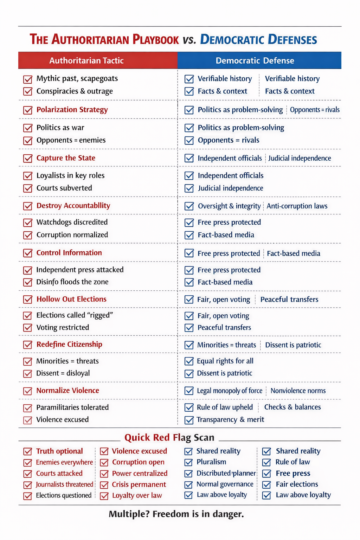
- How democracies slide (pattern recognition)
Historians and chroniclers of societies, over decades, that have slid from democracy into authoritarianism have identified a pattern, a checklist, a playbook.
Understanding what is happening does not fix everything, but it can give you a sense of empowerment through meaning and sense-making.
I added an image in the appendix that lays out this pattern along with corresponding democratic defenses.
- How propaganda works (discernment)
Propaganda aims to hijack attention, polarize communities, and destroy shared reality.
Unfortunately, the system through which we collectively perceive information, collectively process that information, and collectively make decisions based on that information — that system is broken.
Mis- and disinformation literacy is even more critical than ever in this digital, AI age.
- What your rights are (practical and legal empowerment)
Knowing your rights makes you less easily intimidated, helps you understand your own or another’s legal options, and helps you hold your own when talking with law enforcement.
Information warfare and propaganda: protecting your mind online
A simple definition: information warfare is the strategic manipulation of attention, emotion, and belief to create paralysis, division, and obedience.
Practical media hygiene:
- set “news windows” (e.g., 20 minutes morning, 20 minutes evening),
- avoid algorithmic feeds as your primary source,
- diversify sources and check primary documents when possible,
- notice when content is engineered to spike rage or fear,
- practice “slow truth”: wait, verify, cross-check.
(One resource I like: Ground News, which tries to make transparent the biases in reporting and coverage.)
Snyder emphasizes the vulnerability created when we lose our relationship with facts and language. (The Guardian)
NVC might add: when you’re activated, your capacity to discern decreases. Regulate your nervous system and get connected to your needs first, then research.
Self-care as care for the whole
There is a misunderstanding that self-care is selfish. In reality, self-care is a form of capacity maintenance.
If you are trying to be useful or helpful while chronically depleted, you deplete your capacity to serve even further. You can become emotionally or energetically brittle.
People who only focus on their external actions without taking time to replenish and get resourced again can become reactive. You snap one time and then appear to be turning on your allies. It becomes easy to lose nuance and even become susceptible to manipulation.
Your ability to return to being internally resourced is like a fountain. A fountain cannot give water outside of itself if it is not first filled with water.
You fill yourself with energetic and emotional resourcing — so that you can stay grounded, clear-headed, capable — and then you have so much more to give to others!
What does minimum viable self-care in authoritarian times look like?
- protecting your sleep,
- making sure you are taking time to move your body,
- having at least one relationship that is emotionally safe, but ideally many more,
- having a place where you can connect with nature (or even just a daily “sky minute”),
- having a practice that returns you to yourself, for awareness, self-connection, processing, and integrating your experiences,
- having a practice that gives you meaning. This could include prayer, meditation, journaling, artwork, music, or any number of restorative activities, alone or in community.
From numbness to agency: why action heals despair
Despair often lifts not through thinking, but through doing.
Not because action fixes everything — but because action can restore agency, belonging, meaning, and effectiveness.
This is “active hope”: not optimism, but the willingness to contribute without guarantees. (Active Hope)
What nonviolent social change actually looks like
The name Nonviolent Communication came from Dr. Rosenberg’s desire to align what he was doing with Gandhi’s social movement of nonviolence — which in the Hindi language came from words that pointed to both the power of the truth and compassion.
And when you considered what Gandhi did, it was historically unprecedented. It was the first time that an occupied and subjugated people kicked out their colonizers — without a war.
And this is at least in part why Martin Luther King, Jr., also took a page from Gandhi’s book and embraced the mantle of nonviolence.
In his words, ”Nonviolence is the answer to the crucial political and moral questions of our time; the need for mankind to overcome oppression and violence without resorting to oppression and violence.”
Nonviolence is not passivity. It is organized, disciplined, strategic power that refuses to reproduce the opponent’s moral frame.
Key components of effective civil resistance include:
- clear goals,
- broad coalitions,
- nonviolent discipline,
- training,
- strategic escalation,
- narrative clarity,
- resilience under repression.
Participation matters, but so does quality—training, planning, messaging, and discipline. (See the 3.5% rule)
Concrete ways to contribute without burning out
Here are some practical options for you to consider, grouped by “risk level” and kinds of roles.
Low-risk (vital, often overlooked)
- support independent journalism financially,
- host a community dialogue or study circle,
- teach NVC and conflict skills inside your networks,
- volunteer for voter protection, civic education, or local mutual aid,
- help neighbors with logistics (rides, childcare, food),
- build community emergency plans (contacts, check-ins).
Medium-risk (more public, more exposed)
- join peaceful demonstrations with preparation,
- court watching / public accountability efforts,
- community safety accompaniment (walking people home, presence teams),
- rapid response networks for targeted groups,
- canvassing and civic mobilization.
High-risk (requires training + legal support)
- civil disobedience,
- investigative and whistleblower support ecosystems,
- targeted campaigns against specific institutional abuses.
(Rather than be romanticized; high-risk work should be organized.)
Key Differentiation in NVC: Protective Use of Force vs Punitive Use of Force
This is where NVC becomes politically mature.
Marshall Rosenberg’s distinction is direct: protective use of force is about preventing harm, not causing suffering. (PuddleDancer Press, see #139.)
Applied politically, that means:
- we can demand safety and accountability,
- we can set boundaries,
- we can support lawful constraints on harm without making punishment and humiliation our emotional fuel.
Punitive energy is seductive because it feels like power, but it often reproduces domination logic. Protective energy is harder — it requires more training and self-discipline — and it’s the only use of force that can sustain a culture of democracy.
Staying safe without becoming paranoid
Safety is real. Repression is real. Surveillance is real. And paranoia is also real.
A mature posture is: prepared, connected, and not alone. (Building community and preventing isolation go hand in hand.)
Practical safety basics:
- attend events with one or more buddies,
- have a check-in plan,
- carry minimal personal data when protesting,
- keep emergency contacts written down,
- know local legal support resources,
- debrief with care afterward (trauma can accumulate).
Practice nervous-system recovery after any actions. Your body needs to metabolize intensity.
If you can do this in community, that is ideal, because the sense of connection, solidarity, empathy, and support will all be greater.
However, I would also want you to get good at doing this alone — simply because sometimes that will be the most readily available option. And I wouldn’t want you to lose access to nervous system recovery if members of your community are not available.
Knowing your rights: civil liberties as psychological protection
Lacking awareness of your legal rights could leave you more vulnerable than necessary!
Though a full legal guide is beyond the scope of this article, here are some key anchors for the US context:
- The First Amendment protects rights to speech, press, assembly, and petition — core to protest and civic participation. (American Civil Liberties Union)
- The Fourth Amendment protects against unreasonable searches and seizures — core to privacy and protection from abusive intrusion. (American Civil Liberties Union)
- Due process protections — commonly associated with the Fifth and Fourteenth Amendments — matter for resisting arbitrary detainment, arrest, punishment, and unequal treatment.
Knowing your rights doesn’t erase risk, but it can reduce helplessness — and can help you plan intelligently.
When and if you must interact with law enforcement, knowledge is power.
(For practical guidance, the ACLU’s protest rights resources are a strong starting point.) (American Civil Liberties Union)
Talking about politics without losing your soul
It’s easy for our thoughts about politics to become quickly overcome with emotion — anger, sadness, feelings of helplessness or hopelessness, resentment…
And the pattern we see: when we are hurting emotionally is when we tend to lash out or withdraw.
NVC has a great number of tools for emotional self-care, especially self-empathy — as well as knowing how to ask for that kind of support from others.
When I don’t take care of myself in these ways, it’s easier to fall into traps based on my old thinking that rely on dehumanizing, degrading, or demonizing language. They’re animals. They’re subhuman. They’re evil.
And then, often without noticing, I’ve become what I earlier despised: someone committed to being right at almost any cost — and with a diminished sense of my own humanity.
This is where grief work can be so valuable!
In addition to emotional support in the form of empathy or self-empathy, and in addition to grief work, two NVC commitments can help a lot:
1) Empathy is not agreement.
You can give someone the experience that you understand where they’re coming from and still strongly disagree!
NVC helps you listen for the deeper needs, without endorsing any harmful strategies.
2) Boundaries are love.
If you find yourself emotionally unable to continue — perhaps you’re exhausted, or perhaps you notice that you are getting triggered and cannot in this moment continue on a positive, constructive path — you can say something along the lines of: “I’m not willing to continue this conversation if I’m being insulted or threatened,” or, “I notice I’m not as present as I would like to be which tells me I need to go take care of myself.”
Of course, these suggestions are without context, and there is no script to follow!
NVC teaches empathy and honesty and self-connection. Once you are skilled in these, it’s much much more art than engineering. You are improvising, winging it — but with tremendous skill.
Whether you choose to speak, listen or do something else — that all comes from the quality of your connection with yourself including your inner dialog, your present needs, what you actually want, and what options appear available to you.
When choosing to engage — if I’m able to I often go with empathy first, simply because I understand that helping them feel heard can likely deescalate, and the insight that the other person is more likely to hear me out if they feel heard first!
To paraphrase Marshall Rosenberg, empathic connection before correction or education!
And sometimes the most NVC-aligned thing you can do is to disengage and focus your energy somewhere else.
At the end of the day, one of the biggest limiting factors will be your skill level. This is in part because the greater your skill level, the better you’ll be able to deal with more intense and complex situations. And that increased ability gives you massive confidence (speaking from experience).
Remember that there is an important difference between having a tool and being skillful with a tool.
I encourage you to prioritize developing and deepening your skills, because, as the saying goes, you want to dig your well before you’re thirsty.
For training possibilities in your area, you can do an online search and check out the Center for Nonviolent Communication (CNVC).
Hope without denial
Hope, as I’m using it here, is not the belief that everything will be fine. Hope is the decision to contribute anyway — not from the standpoint of any outcome having a guarantee, but because what else would you do?
Snyder’s framing points to a sober kind of hope: refusing pre-compliance, protecting facts, showing up in person, supporting institutions, building solidarity. (Scholars Strategy Network)
Joanna Macy’s “active hope” is similar: the practice of choosing your response — rooted in love — despite having no guarantees. (Active Hope)
NVC might add: hope becomes stable when it is connected to needs and community, not outcomes.
Political despair as initiation, not defeat
If you let them, these times can initiate you into a deeper adulthood. I’m referring not to an adulthood of cynicism, depression, and hopelessness pretending to be “mature” and “realistic” — but rather, a maturity of stewardship, attunement, care, and a connection with your own humanity.
Political despair can signify the end of a fantasy: Someone will handle it.
What comes next is the birth of something stronger: We belong to each other.
This may sound like spiritual language, yes. And it is also civic realism grounded in the only viable path forward. We can continue living as if we are separate, disconnected, and that there are no consequences. Or we can acknowledge our interconnectedness and interdependence, and move from there.
The pain of political despair can deepen your wisdom and compassion — especially if you use it that way intentionally.
Reflection questions (NVC-aligned)
Use these slowly. Don’t answer them all at once. You can work with them alone, or in a small group of trusted allies.
- What am I most afraid of — and what need is underneath that fear?
- What am I grieving — or, what breaks my heart — that I haven’t fully named?
- Where am I demanding certainty before I act?
- What is one small action that would restore my sense of agency this week?
- What support would make my engagement sustainable for six months?
- What conversations am I avoiding because I fear conflict or rejection?
- How do I want to remember myself during this time?
Closing — Choosing presence over paralysis
If you feel despair, it may be because you are still capable of love, still capable of conscience, still capable of being moved by what happens to others.
That capacity is not your weakness. It’s your access point.
Authoritarian systems try to make people smaller: isolated, frightened, reactive, obedient, cynical, numb. NVC is one way we refuse that shrinking — by returning again and again to what makes us human: feelings, needs, honesty, empathy, and courageous requests. Caring. Hurting. Showing your heart through vulnerability, and attending to others’ pain with tenderness.
Staying human represents a powerful first act of resistance.
Remember that you do not have to do everything. You probably need to do something — sustainably, with others, rooted in values.
Be calm when the unthinkable arrives. Do not obey in advance. Mourn what you love. Protect life rather than punish. Build community. Learn your rights. Tell the truth. Take the next step. And the next. One centimeter at a time.
References and further reading
- Marshall Rosenberg (NVC resources, including protective vs punitive force). (PuddleDancer Press)
- Timothy Snyder, On Tyranny (official site + civic lessons). (timothysnyder.org)
- Anne Applebaum, Autocracy, Inc. (authoritarian networking, kleptocracy, propaganda, surveillance “best practices”). (anneapplebaum.substack.com)
- Erica Chenoweth (civil resistance effectiveness; 3.5% as a rule of thumb). (Harvard Kennedy School)
- ACLU “Know Your Rights” — Protesters’ Rights; Search & Seizure. (American Civil Liberties Union)
- Polyvagal Institute (overview of Polyvagal Theory). (Polyvagal Institute)
- Joanna Macy (Work That Reconnects spiral; Active Hope). (Joanna Macy & Her Work)
Marshall Rosenberg on NVC and Positive Social Change
The year was 1996 and I was in a workshop led by Dr. Rosenberg. (I just called him Marshall.)
It was my second or third workshop with him, and I was enthralled by how he described the possibilities of social change, including anecdotes from his life, and the behavioral patterns and dynamics that make positive efforts ineffective and unsustainable.
It clarified so much!
When relationships in a project, an organization, or a movement degrade, and trust is damaged, people question each others’ motives and effective teamwork weakens.
I saw then the potential that NVC has as a tool for people who want to influence positive change, and I was fascinated. I approached Marshall at the end of the workshop and told him so, “Marshall! NVC could really change the world!” He replied with a smile and a glint in his eye, “I’m increasingly less afraid of that possibility!”
Marshall understood nonviolent persuasion, which involves truthfulness, vulnerability, and also empathy for the others’ perspective.
(And he repeated many times empathy is not agreement! Neither is it condoning nor justifying! And despite me repeating that, some people will still have a hard time understanding the next sentence: Marshall grew up Jewish, and he shared openly that it took him about a decade to be able to have empathy for Hitler’s choices.)
Nonviolent persuasion has nothing to do with manipulation or coercion — it works because of connection! When we can create mutual understanding about each others’ needs, we are more likely to find mutually agreeable solutions.
And yet, one of the limitations of NVC is access! If someone is not available to engage in sincere dialog you don’t have access, which means that the kinds of results and outcomes that are possible with NVC recede out of reach. (In some cases we can create access — either on our own, or strategically, through others.)
Marshall understood that sometimes force is necessary to protect life. And this is why he gave us this incredibly important distinction between protective use of force and punitive use of force.
Any unilateral action, he would say, has to be a last resort. Protective use of force comes into play when you have exhausted all other possibilities. You have checked that you are not in a “crisis of imagination” — and have genuinely left no stone unturned. In some circumstances there is an imminent threat, no other options appear available, and we must act decisively.
(An illustrative example would be if my 2 year-old runs into a busy street. I will use my physical strength, against their will, to remove them from the street and put them somewhere safe. I may be scared or have had an adrenaline rush, but no part of me is in a punitive mindset.)
Short of the need for unilateral and protective force, Marshall understood that nonviolent action and dialog required a certain persistence and perseverance that would be impossible without a lot of self-care, including receiving high quality empathy.
Marshall used to say that social change equals any given number of NVC conversations.
What did he mean by that? How does that work?
To continue on that thread, I recommend the article Nonviolent Communication and Social Change.
PuddleDancer Press Books on NVC, Personal Empowerment, and Positive Social Change
PuddleDancer Press is the foremost proponent and publisher of books on Nonviolent Communication, personal empowerment, and positive social change.
NVC has shown time and again that human beings are capable of arriving at co-created, long-lasting solutions.
Because of the trust-building process involved, and the fact that the solutions include everyone’s buy-in, using NVC for personal empowerment and positive social change predictably gives us outcomes that meet a greater number of needs and are more durable.
Our books on personal empowerment and positive social change can help you:
- Create exceptional personal and professional relationships,
- Offer compassionate understanding to others,
- Know when and how to ask for that same understanding for yourself,
- Prevent and resolve misunderstandings and conflicts,
- Speak your truth in a clear, powerful way more likely to lead to harmony than conflict,
- Create mutual understanding without coercion.
Whether you are a long-time student or are brand new to NVC, PuddleDancer Press has the educational resources — including the books on personal empowerment and positive social change — to help you grow your emotional intelligence, interpersonal skills, and communication prowess.
Check out our catalog of books on personal empowerment and positive social change… and give yourself the gift of Compassionate Communication!
Appendix: The Authoritarian Playbook versus Democratic Defenses
I used ai to create the following image — a simple but thorough version of the authoritarian playbook checklist, with corresponding democratic defenses, based on the work of Anne Appelbaum and Timothy Snyder.