



The Science of the Heart: Nonviolent Communication and the Scientific Method
by Alan Rafael Seid, CNVC Certified Trainer
What exactly is science, and what is “the scientific method?”
What is Nonviolent Communication (NVC)?
Can NVC be studied in a scientific way?
Can science prove (or disprove) the effectiveness of NVC? How does that even work?
Can science inform NVC — and can NVC inform science?
Intro: A Language of the Heart meets an Exercise of the Mind
In this article I examine the places where Nonviolent Communication (NVC) meets the scientific method, and the areas where NVC and science overlap.
First I will define NVC followed by a clarification of what science and the scientific method are and aren’t.
Then we will look at a fascinating nuance that shows us how practices like NVC and mindfulness can be examined with scientific rigor.
What is Nonviolent Communication?
Nonviolent Communication (NVC) was developed by Marshall Rosenberg, PhD, starting in the 1960s.
NVC is simultaneously a consciousness practice as well as a framework for deepening relationships and resolving conflicts in a mutually satisfying way.
And it accomplishes so much more than this! So let’s look at it more closely:
Where does the name come from?
Dr. Rosenberg (or Marshall) named it Nonviolent Communication (NVC for short) in an attempt to align the work with Gandhi’s social movement of “nonviolence” — which at its core was about a fierce dedication to truthfulness along with a commitment to compassion and reducing harm.
The two words they used in India in Gandhi’s time were satyagraha and ahimsa. Satyagraha roughly translates as soul-force, soul-truth, the power of the truth, or a journey one endeavors to discover Truth. Ahimsa roughly translates as harmlessness toward all beings, or I am not your enemy, and is similar to the Buddhist concept of loving-kindness.
There is no direct translation into English for these words, so the concept was translated as nonviolence — but, again, it is vaster and deeper than a lack of violence.
The process is also known by other names including compassionate communication, life-connected-life-serving communication, empathic communication, empowered communication, and others.
Each of these names gives you a different sense of what the process is about and what it is used for.
The History of NVC
In part, NVC grew out of a deep-seated question that troubled Marshall Rosenberg. This question had to do with two very different kinds of smiles.
He had been scarred by the racism and anti-semitism he encountered growing up in Detroit — and recounted a period in his life during which a group of boys waited for him every day after school to beat him up. And they smiled while they did it.
During the same period, his uncle would come over to his house to take care of Marshall’s bed-ridden grandmother (his uncle’s mother). The uncle would bathe her, feed her, and provide care and companionship — and he also smiled while he did it.
These were two very different kinds of smiles!
On the one hand was the uncle’s smile. He seemed to genuinely enjoy contributing, being of service, and acting from a place of love. On the other hand were the boys’ smiles, indicating that they seemed to enjoy inflicting violence on another.
That got Marshall wondering, how come? Why is it that being of service seems so deeply fulfilling, while at the same time some people seem to enjoy exacting violence on others?
Years later, Marshall became a student of famous psychologist Carl Rogers, who at the time was studying empathy and the question of why authentic human connection can be so healing.
Marshall realized that when the quality of a relationship was low people tended to be more focused on questions of who was right, who was wrong, and who was to blame. Conversely, when the quality of a relationship was high, people tended to naturally be more patient, tolerant, and understanding.
When a relationship feels connected, people spontaneously preference contributing to each other along with a willingness to work toward mutually beneficial outcomes.
This seems simple, but it is a remarkable insight!
The quality of the connection being high — or low — makes all the difference to how we treat each other, whether or not we contribute to one another, whether we can work well together, and whether or not we explore conversations about possibilities!
So Marshall set out to distill the essential elements in thought, language, communication, and the use of power that lead toward positive, close, mutually satisfying relationships. This was the start of NVC!
During his development of NVC, Marshall also came to understand the type of thinking and language that destroys trust and closeness in relationships. This happens to be the same type of thinking and language that leads people to enjoy violence — and through which a society in which the few control most of the resources, over the many, is justified.
The Purpose of NVC
The purpose of NVC is fairly straightforward, but can be described from different angles.
Generally speaking, the purpose of Nonviolent Communication is to create the quality of connection out of which people naturally and spontaneously enjoy contributing to one another’s well-being.
This is the essence!
From the perspective of honesty and self-expression — the purpose of NVC involves how to speak your truth so that it is most likely to be met with understanding, and is most likely to result in your own needs being met in a way that is also in harmony with the needs of others. NVC shows you how to express your point of view in a way that is most likely to lead to harmony rather than conflict.
From the angle of listening — NVC is about how to be on the receiving end of blame, judgment, criticism, or a verbal attack and — instead of hearing those things — be able to put your attention on what might be the other person’s values or needs. This means that you’re less likely to get defensive, more able to stand in a compassionate place, and much more likely to defuse any potential conflict.
From the standpoint of self-connection, including your self-talk — NVC is about having interior clarity and constructive intra-personal communication. NVC helps you have interior clarity about:
- what you are observing vs what you’re telling yourself,
- what you are feeling vs thinking,
- what is motivating you in your core — the life-impulse or universal human need behind what you’re wanting, and,
- what, specifically, you could request, of yourself or another, to contribute to needs or to create concrete forward movement, a next step.
NVC Consciousness as distinct from The NVC Framework
NVC has a concrete framework as well as “tools” with which you can become more skilled.
But NVC primarily is the consciousness and the intentionality that you bring to your interactions.
The tools, by themselves, without the underlying consciousness result in something that is far from NVC! (When people say they experienced NVC being weaponized, this is what they’re talking about.)
If your intention is to create a high-quality connection, and along with that you have a willingness to work toward a mutually satisfying outcome, that is aligned with NVC.
If your intention is to manipulate a specific outcome or “get your way,” then no matter how skilled you are at the tools and framework side of NVC, it will never be NVC!
So the consciousness is paramount — and you become more skilled with the tools over time.
For an understanding of the framework side of NVC, I am attaching an image created by my late colleague Inbal Kashtan titled The NVC Tree of Life.
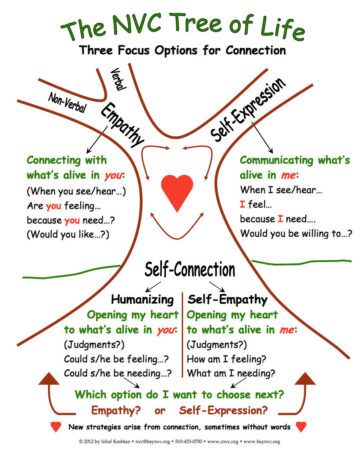
What you’ll notice are three areas. The two branches correspond to speaking (self-expression) and listening (empathy), while the trunk and the roots correspond to self-connection.
You will notice from this image that each of these three areas has the four components of the NVC Model: observation, feeling, need, and request.
I will refrain from going more deeply into the framework itself here, but please do see the section below titled “Developing Your NVC Skills” which has some pointers for how to progress.
Next, let’s look more closely at the practical results people experience when they apply NVC.
Practical Results of the Application of NVC: personal experience, stories, and examples
Below are some examples from my life.
But besides me, there are tens of thousands of people, if not more, who report improved self-awareness, improved relationships, bringing less work-related stress home, and less home-related stress to work. With practice, results include an increased ability to lower your own emotional charge in situations when that really matters.
As a 30+ year student of NVC, and with more than 20 years as a Certified Trainer, I have witnessed, participated in, and facilitated awe-inspiring personal and relational healing — hundreds if not thousands of times!
Below are some examples of the power of NVC in my personal life as a way of rounding out this explanation of what NVC is.
How I got Divorced and Kept My Family Together
If you don’t know this story, I personally hold it as a treasured life accomplishment.
It’s also the title of a future book, in which I hope to share the full scope of the story.
After 22 years together with my college sweetie, 3 children later, and a nearly two-decade NVC conversation, we came to an understanding. Nobody was “bad” or “wrong” — but we were like two shrubs, one that thrives in alkaline soil and one that thrives in acidic soil, and neither of us was thriving. So we did a healthy “re-potting,” transforming the roles “husband” and “wife” to “friends-and-co-parents.”
It turns out that you can have a lot of love, and great communication skills, and still genuinely want different things in life!
We separated in 2015 and for the next two-and-a-half years we had sit-down dinner as a family five nights a week. One night a week she would have the kids and I would have the evening off, another night a week I had the children and she would have the evening off — and the remaining five nights were family time. This is after the separation and during the divorce.
How?
NVC. That’s it. Of course there is a longer story, but in the end two people showed up with a shared intention to work together for the sake of the kids — and then used excellent tools (NVC) with a high enough level of skill. The relationship and the process itself helped to improve each of our communication skills — but only because we intentionally approached it that way!
I’m over at their house almost every day, and she and I coordinate on-the-fly about transportation schedules or setting up a time to talk about school or finances. One of the biggest needs met for me is ease!
Divorce — or simply allowing for a shift in relationship roles — doesn’t have to become a war.
So often, when couples decide that their relationship has run its course, they don’t know anything other to do than to go to war. It becomes a battle of win vs lose, and if there are children they will certainly lose in these scenarios.
I knew another way was possible, and NVC is what helped me navigate that other path in a way that allows me to be very close with my children and have positive regard and ease in relation to their mother.
Family Repair and Conflict Mediation Work
Recently I have been approached by families that have experienced disconnection, alienation, and estrangement.
The way I bring my skills to this domain is different than someone might expect. I don’t start with everyone in the room — we end there.
So how does it work?
First, I have all the one-to-one conversations. Everyone receives empathy from me for their pain (which is not the same as agreement with their story). We create a connection, I build rapport and trust for the work to come.
Speaking to each person gives me a sense of all the perspectives and a broader awareness of the issues.
And I ask everyone the same questions.
One of those questions is: if we could solve a conflict between any two individuals involved, and solving that conflict would affect the entire group positively, who would those people be?
We then proceed to the healing and reconciliation between each pair of individuals. In preparation for the facilitated conversation, I conduct a Healing and Reconciliation Role-Play — an advanced NVC practice — with each individual, one to one. Shortly after the role-plays we conduct the mediation or facilitated conversation.
What does the Role-Play accomplish?
After the role play my client is more connected to their feelings, their needs and underlying motivations, and any possible requests they might have of themselves or others. And equally importantly, they come out with a lowered emotional charge.
This is the perfect state with which to enter a conflict mediation with a family member. The role plays can be profound, and a mediation is usually hard but fulfilling work. And the higher the NVC skills applied to these processes, the more extraordinary the results.
After the necessary mediations, the group can be in the same room or the same Zoom call together with significantly lower tension and with a palpable potential to re-build trust.
I led almost the exact same process that I do with families with all the teachers at an elementary school. This group had devolved into two factions that had developed contempt for each other. The process took about four months, but by the end they were reporting, live on a Zoom call, that they felt like a cohesive team that could once again work together.
Coaching for Leaders at Work
NVC as applied to leadership has shown me astounding results!
I see it simply in my children having grown up in a home that had observation, feelings, needs, and requests literacy. In their case, it was an unintended positive consequence of mom and dad having a high level of NVC before kids.
I also coach leaders who want to improve their communication skills for better teamwork, reduced conflict, and mutually satisfying outcomes at work.
At the higher levels I’m used as a consultant for organizational culture. It is my contention that a culture that is aligned with NVC will have better staff retention because people will be happier at work. After all, staff turnover is very expensive for companies that have a more conventional, and alienating, culture. Even if their motivation initially is saving money because of reduced staff turnover — they receive so much more that, in time, they learn to value.
A recent coachee said she felt tension between herself and a client, but didn’t know how to broach it or overcome it. We worked on this. I gave her some frameworks to better understand the dynamics and what is possible. And we role-played some possibilities. We worked on her emotional regulation and how to help the client feel heard. And at our next call she reported having completely turned around the energy and the dynamic in that relationship to something much more collaborative and generative. The return on investment for this particular company is hard to overstate.
For my client especially, this is a valuable benefit of NVC applied to leadership.
Famous Author Quotes
As part of the anecdotal, rather than the rigorously scientifically tested, evidence for NVC, here are some quotes from well-known authors about NVC. These will give us a backdrop for the discussion that follows.
“NVC is one of the most useful things you will ever learn.”
William Ury, Getting to Yes
“NVC provides us with the most effective tools to foster health and relationships.
Anthony Robbins, Awaken the Giant Within and Unlimited Power
“These dynamic communication techniques transform potential conflicts into peaceful dialogues.”
John Gray, Ph.D., Men are from Mars, Women are from Venus
“I believe the principles and techniques in NVC can literally change the world!”
Jack Canfield, Chicken Soup for the Soul series
“These books are worth their weight in gold.”
Jan Hunt, The Natural Child
“NVC gives people a way of listening so others feel not just heard, but understood.”
Thomas Gordon, Parent Effectiveness Training
“It would be hard to list all the kinds of people who can benefit from reading these books, because it’s really any and all of us.”
Michael Nagler, Is There No Other Way?
“Applying the concepts within these books will guide the reader toward fostering more compassion in the world.”
Marianne Williamson, A Return to Love
The Limitations of NVC
Like any modality, NVC has its gifts and its limitations. Some of the gifts of NVC are truly remarkable! What are its limitations?
- Access — If two people are punching each other or two groups are shooting at each other, we don’t have access to the kind of dialog that would lead to different, mutually satisfying solutions.
- Skill-level — The higher your skill level, the more confidently you can engage in meetings, enter conflicts, and navigate relationships. The higher your skill level, the more meaningful your interventions can be.
- Clear understanding — This applies to clarity about what NVC is and is not, what it can do and what it cannot do. Some people are not aware of the remarkable results NVC makes possible. And some people expect NVC to also make them coffee, do their accounting, and take the dog on a walk. (You can bring NVC with you when you do these things, but it will not do them for you.) Some people have experienced NVC applied only with a low skill level — or even worse: weaponized NVC! (This is when someone claims they are “doing” NVC and uses language that sounds like NVC, but they are aiming to be right or trying to manipulate the situation to get to a specific outcome — no connection, just a result.) If this is all someone ever experiences of NVC, they could be missing out on some massive positive potential!
Developing Your NVC Skills
NVC is typically taught in a workshop or classroom setting — and there are many options, online and offline.
You can learn more about the basics of NVC, here.
This book is a classic text for learning the concepts of Nonviolent Communication.
Having a tool and being skillful with a tool are different! I highly recommend building your NVC skills through online or in-person workshops and attending a practice group.
Besides workshops and a practice group, if you want to go deep, I highly recommend attending an International Intensive Training (IIT) put on by the Center for Nonviolent Communication (CNVC). At an IIT you live immersed for about 9 days with a group of people sharing the intention to learn NVC — which is one of the most effective ways to deepen your understanding and skills.
What Is the Scientific Method — and Why Should You Care?
The scientific method in its simplest form:
At its core, the scientific method is a repeating cycle.
Let’s use an everyday example from home to look at the scientific method in its simplest form: plants near the window compared to plants not near a window.
1. Observe something that catches your attention.
Observation: Plants near the window grow faster.
2. Guess or propose what might explain it (this is your hypothesis).
Hypothesis: More sunlight causes faster growth.
3. Make predictions based on that observation. A strong scientific hypothesis doesn’t just explain what you’ve already observed; it predicts what you should observe next if the hypothesis is correct.
Prediction: If I give another plant the same extra sunlight, it should also grow faster.
4. Test those predictions and look honestly at what happened — whether it confirmed your guess or not.
Test: I place a plant that had been in a darker area so that it is now by the window, and compare its growth over a given amount of time to the growth of plants I left in the darker area.
5. If the results don’t fit, revise your explanation and repeat the cycle. If they do fit, keep testing and invite others to do the same. Repeatability is built into the scientific method, because one successful test is usually not enough to prove consistency across time and contexts. Scientists repeat experiments and encourage others to repeat them independently in order to confirm or refute the potential explanation (hypothesis).
This last part, having others look at your results to confirm or refute is very important, and will be valuable up ahead when we look at the three strands of deep science — and how all of this interfaces with NVC.
The goal isn’t merely to confirm a hypothesis. When evidence doesn’t fit, scientists modify or abandon the hypothesis and start the loop again so that we can truly understand what we are seeing.
Science is also a social process. Results are published, criticized, replicated, and challenged by other scientists.
Those 5 steps, above, are the scientific method in a nutshell. Of course there is nuance. But everything else — lab coats, peer-reviewed journals, electron microscopes — is just part of the same loop, in more elaborate expressions.
One subtle point: philosophers of science such as Karl Popper would argue that science advances less by “confirming” hypotheses than by trying to find situations where they fail.
In that view, step 4, above, would shift from “Did my guess turn out to be right?” to “Did my test reveal that my guess is wrong?” That’s a small change in wording, but it captures an important scientific attitude.
Science attempts to stick to factual evidence independently of whether or not I am personally attached to my guess being correct.
As you can see above, what you learn in step four becomes a new observation, which leads to a new hypothesis, which leads to a new test.
Science is less a destination than a spiral — always circling back, always refining.
By the way, and we will look at this up ahead, in NVC we form hypotheses all the time. Carl Rogers, with whom Marshall Rosenberg studied empathy called it an empathic hypothesis, which Marshall often referred to as an empathic guess.
Why did humans develop science in the first place?
The short answer is that humans are exceptional at making up stories that explain things, and we get attached to those stories, whether or not there is any evidence or proof, and whether or not they make sense to other people. For humans, the capacity to fool ourselves is built in!
Sometimes we see patterns that aren’t there, we remember the hits and forget the misses, and, so often, we believe what we want to believe, and then unconsciously arrange the evidence to support it.
Psychologists call this confirmation bias — and it’s not a flaw in some people — it’s a feature of human cognition in general, including yours and mine.
The scientific method was developed as a set of guardrails against this tendency. It’s a way of asking: what would I have to see to know I’m wrong? And then actually looking. (This could be scary if my ego is attached to being right — especially if “being right” is part of how I source my self-esteem!)
Before the scientific method became widespread, most explanations for how the world worked came from authority — from tradition, from scripture, from whoever held power.
If a king or a priest said it was so, it was so. To share one poignant example, in 1663 Galileo Galilei was found guilty of heresy by the Catholic Church, and spent the rest of his life under house arrest for supporting the idea that the Earth moves around the Sun. His evidence-based assertion went against tradition and a power-structure that felt threatened when questioned.
Before the period in Europe referred to as the Enlightenment, art, artistic expression, and explanations about how the world works (science) were under the complete control of the church.
The scientific method shifted the question from who said it to what does the evidence show. This supported the historical shift in Western cultures that allowed art and science to pursue their own directions without being under the yoke of the church. That was a revolution!
What makes something “scientific” versus just an opinion or belief?
Here’s the key — and this gets into the nuance I want to explore with NVC: a scientific claim has to be testable. Even more importantly, it has to be falsifiable. That word sounds technical, but the idea is simple.
A falsifiable claim is one where you can, at least in principle, imagine evidence that would prove it wrong.
“Exercise improves mood” is falsifiable. This is different than saying it’s false. In other words, in how the claim is formulated there are ways to find out whether or not it is false. You can measure mood before and after exercise, across many people, and see if the pattern holds. If it consistently didn’t, you’d have grounds to revise the claim.
“Everything happens for a reason” is not falsifiable. There’s no evidence you could gather that would disprove it — which means it also can’t be confirmed by evidence! It lives in a different category of knowing. Not lesser, necessarily — just different.
This distinction matters enormously for our purposes, because NVC deals largely with individual and shared interior experience — feelings, needs, the quality of connection between people, whether or not people have shared values or shared intentions, and so forth.
It’s easy to see that individuals have interior experience (the subjective space of intentions, thoughts, feelings, needs, etc.) — but interpersonal reality ALSO has an interior dimension. The technical term for this is intersubjectivity.
Whether or not we have shared perspectives or values, compatible intentions, a similar worldview — none of this can be weighed or measured in a conventional quantitative way. And that doesn’t make it less real!
The question we’ll be exploring in this article is whether that territory can be approached with genuine scientific rigor, or whether it must forever remain in the realm of the “merely” subjective and intersubjective.
The Garden Analogy — You Already Do This
Let’s take our previous analogy of plants in the house out to the garden, for a simple example that might make all of this feel more familiar.
Imagine you’re a home gardener, and you notice that the tomatoes on the south side of your garden are ripening faster than the ones on the north side. That’s an observation.
You think: maybe it’s because the south side gets more direct sunlight. That’s a hypothesis.
Next season, you plant identical tomato varieties on both sides, same soil, same water, same fertilizer — changing only the sunlight exposure. That’s your test — and notice that you’re trying to keep everything else the same so you can isolate the one variable you’re actually curious about.
At the end of the season, you look honestly at what happened. The south-side tomatoes ripened earlier again. But you also notice that the soil on the south side drains faster after rain. Now you’re not sure if it was sunlight or drainage — or both. So you design a new test. The spiral continues.
You have just done science — no lab coat required.
Now here’s where it gets interesting for NVC practitioners. Suppose you notice something in your relationships: on the days when I start a difficult conversation by naming what I’m observing — without blame — it tends to go better than when I lead with what the other person did wrong.
That’s a form of observation — seeing a pattern regarding how difficult conversations go based on a difference in that one variable.
You could form a hypothesis: separating observations from evaluations reduces defensiveness in the person I’m talking to.
You could then test it — deliberately, across different relationships, different conversations, different stakes. (I believe this is in large part what Marshall Rosenberg was doing as he developed NVC. The development of NVC was evidence-based!)
You look honestly at the results. Sometimes it works beautifully. Sometimes it doesn’t — and that’s data too.
I do this kind of testing in the realm of cooking all the time! I form a hypothesis about what could turn out to be delicious, I test it, I receive the data/feedback, and I adjust — and then I try it again!
This is exactly the kind of inquiry NVC invites. And as we’ll see, there’s a way to apply this kind of rigor to inner and relational experience. But first, we need to look at what conventional empirical science leaves out.
Why does this matter to someone learning NVC?
This matters because at some point, almost every person new to NVC experiences the same doubt — either from themselves or from someone they’re trying to convince:
“That sounds nice. But does it actually work?”
Or its cousin: “Feelings and needs — isn’t that just touchy-feely stuff? Where’s the evidence?”
(And so many other concerns and objections I have heard people raise over the years!)
When these are sincere questions, I want to give them real answers — not defensive ones, and not dismissive ones.
After all — as an NVC practitioner, I’m not here to defend NVC as if it were a cult or an orthodoxy of belief!
The goal of this article is to explore those answers: to show that NVC can be examined with genuine intellectual rigor, and that the evidence — gathered through multiple valid ways of knowing — is substantial.
But to get there, we first need to look honestly at what conventional science can and cannot do.
The Limits of Conventional Science — What Gets Left Out
First, let’s define the term empirical — because what I mean by conventional science is usually referred to as empirical science.
Empirical means based on experience — observation, testing, or experiment — rather than on pure theory or abstract reasoning.
In the context of empirical science, it means a science that builds knowledge from evidence gathered through observation and experiment, so that it can checked, tested, or revised based on what is observed.
For example, physics, chemistry, biology, and much of psychology are empirical because they rely on measurable evidence from the natural world.
A simple contrast would be a theoretical claim that starts with an idea, while an empirical claim starts with data. If someone says, “We need empirical evidence,” they mean, “We need actual observations or experimental results, not just a hunch.”
What is empirical science good at — and what can’t it measure?
Empirical science — the kind most of us learned about in school — is extraordinarily good at studying the exterior of things. It measures what can be observed from the outside, quantified, and reproduced under controlled conditions.
So it is limited to things that can be weighed and measured.
Science has given us antibiotics, space telescopes, and knowing that washing your hands before surgery saves lives. Science has made possible an investigation of the physical world that our ancestors would have only dreamed of!
But here is what empirical science is structurally — not accidentally, but by design — unable to measure: feelings, values, needs, intentions, desires, somatic sensing, intuition, and so forth.
For example:
- What it feels like to be you, right now, reading these words;
- The felt experience of grief after losing someone you love;
- The specific texture of joy when a long-estranged relationship repairs itself (for me that texture feels also like relief);
- The satisfaction of seeing your inner work produce results in your sense of well-being;
- How your needs for meaning and inspiration are met when you read something that really resonates;
- The experience of being truly heard by another human being after years of not trusting that they get it.
These experiences are not small things. These are, for most people, the central things — the moments around which an entire life is experienced.
And we lose a great deal when we try to reduce interior reality to its exterior components.
These experiences are precisely what a scale cannot weigh, what measuring tape cannot measure, and what a brain scan can only point toward from the outside.
A neuroscientist can show you which regions of your brain light up when you feel sadness, rage, or tenderness. But that image on a screen is not the experience of the feelings. It is more like the footprint of the feelings — the exterior trace of something that is, at least in your personal experience, an interior event.
What happens when we try to reduce inner experience to only what can be measured?
When we reduce interior reality to atoms, molecules, or brain structures we lose something essential — and we often don’t notice what we’ve lost because the tools science has can’t detect the absence.
For example, consider grief. A conventional empirical approach can measure cortisol levels, sleep disruption, immune suppression, changes in appetite and cognitive function. These are real, and they matter.
But a grieving person who was told only this — that their bereavement is a cortisol fluctuation and a disruption to their circadian rhythm — would be correct in having the experience that something important has been left out.
They might experience it as dismissive of their humanity — not necessarily incorrect — but radically incomplete because a clinical assessment is different from care and compassion.
As another example, consider empathy.
Researchers can measure prosocial behavior, response times to others’ distress, activation of mirror neurons. But the actual experience of being so present with another person — that moment of genuine contact where you sense that someone else’s reality has landed for you, where you get it — that is not captured by any of these measurements. It can only be known from the inside.
The philosopher Thomas Nagel made this point memorably when he asked: what is it like to be a bat?
A bat navigates by echolocation — a sensory system so different from our own that no amount of third-person, exterior data about bat neurology could tell us what it actually feels like to be a bat perceiving the world that way. The interior dimension, Nagel argued, is real — and it is genuinely beyond the reach of exterior measurement alone.
Author and philosopher, Ken Wilber, whose work we will touch on later in this article has posited that individuals and collectives have exteriors and interiors — and none can be reduced to any other. This theoretical claim is being substantiated with evidence in field after field — in one domain after another.
When we forget that interior experience is also real, and that it cannot be evaluated with the same tools we use for exterior quantification, we’re not just engaging in bad philosophy — we are doing bad science. We design studies that measure the wrong things, reach conclusions that miss the point, and dismiss as “anecdotal” the very evidence that would most help us understand what’s actually happening.
Has mainstream science ever been wrong about dismissing subjective experience?
At risk of belaboring the point, the answer would be yes, repeatedly, and perhaps constantly. The examples are quite instructive.
For most of the twentieth century, mainstream psychology was dominated by behaviorism — the view that only observable, measurable behavior was a legitimate subject of scientific inquiry. Inner states — thoughts, feelings, intentions, motivations, and consciousness itself — were considered unscientific, even embarrassing to study. What couldn’t be measured from the outside simply didn’t count.
This wasn’t a fringe position — this constituted consensus among scientists, enforced through funding, publication, and professional prestige.
It was also incorrect. The cognitive revolution of the 1960s and 70s broke behaviorism’s grip, largely by demonstrating that you cannot adequately explain human behavior without reference to inner states — to perception, memory, intention, meaning-making, motivations, and so forth. The interior was and is not optional. It is of utmost significance and consequence.
A more recent example: mindfulness and meditation.
For decades, reports of the psychological benefits of contemplative practice were treated by mainstream science with polite skepticism at best, open dismissal at worst.
Meditation and mindfulness have been considered “soft” because they were “subjective.” If something was not measurable with the tools scientists were used to, then it was considered less-than-valid, not a legitimate thing to study.
Then researchers like Jon Kabat-Zinn developed rigorous protocols for studying mindfulness-based interventions — and the results were impossible to ignore.
Today, mindfulness research is published in the most respected peer-reviewed journals in medicine and psychology, and its applications in chronic pain, anxiety, depression, and stress are considered evidence-based.
What changed? Not the inner experience — people had been reporting these effects for centuries, across multiple wisdom traditions. What changed was that science developed better tools and, crucially, the willingness to ask better questions.
The lesson is not that science was useless. The lesson is that science, when it closes its eyes to entire categories of human experience, misses a huge part of the picture and therefore gets it wrong.
But pure science, being what it is, is looking for genuine explanations — so eventually it has to go back and correct itself to account for what it couldn’t explain before.
What is “scientism” — and how is it different from science?
I have found this distinction super helpful — and it’s worth defining now.
Science is a method. It is a set of practices — observation, hypothesis, testing, honest evaluation — for building reliable knowledge about the world.
Science is, as we’ve established, one of humanity’s most powerful tools for getting things right. And science iterates — it updates its understanding.
Newtonian physics, which explains things at our human scale, wasn’t proved wrong by relativity and quantum mechanics — it was simply transcended and included by them. Newtonian physics still explains the apple falling from the tree — but its explanation falls apart at the highest speeds, the most intense gravity, and at the atomic and subatomic scales.
Science iterates and updates itself. Questioning the science is part of science!
Scientism is an ideology. It is the belief that empirical science is the only valid path to knowledge — that if something cannot be measured by third-person, exterior methods, it is not real, not valid, and not worth taking seriously.
Science says: here is a rigorous method for investigating certain kinds of questions.
Scientism says: the only questions worth asking are the ones this method can answer.
I hope you can see the issue here. It’s a little like insisting that a hammer is such a good tool that all other tools are suspect — and then wondering why it’s so hard to take that screw out, or why your plumbing keeps failing.
The philosopher Ken Wilber, mentioned earlier and whose work we’ll draw on more fully in the next section, puts it plainly: scientism is not the ally of science. It is its counterfeit. It takes the genuine authority of empirical inquiry and uses it to colonize — and dismiss — entire domains of human experience that require different, equally rigorous methods to investigate.
This matters for NVC because one of the most common objections to taking NVC seriously as a discipline is a scientistic one: “Show me a double-blind study” — as though the only valid evidence for the power of empathy-and-vulnerability is a randomized controlled trial — and as though the testimony of tens of thousands (hundreds of thousands? millions?) of practitioners, across decades, in dozens of countries and cultures, somehow just doesn’t count — it’s not “real” enough.
It counts. The question is: what kind of science do we need to evaluate it properly?
That’s exactly what we’ll explore next.
The Three Strands of Deep Science — A Bigger Map of Knowing
If you don’t know my story, in 1987 I decide to research, find, learn, integrate, and help to disseminate, the most effective and powerful tools, processes, and modalities that I could find, for living in harmony within ourselves, with each other, and with the planet.
I studied with many teachers and mentors, and eventually that search led me to Marshall Rosenberg, whom I first met and began studying under in 1995.
That search also led me to the work of Ken Wilber, regarded as the most widely read and influential of contemporary American philosophers.
Ken Wilber’s work, and the Integral Framework he developed, is consistent with NVC.
His remarkable accomplishment was creating a conceptual framework that makes room for every area of human knowledge and inquiry and also places them in a larger context. The great value of his work for me is around meaning-making and understanding how things relate to and influence each other. It contributes to my needs around meaning, clarity, and effectiveness across contexts.
(In 2010 and 2011, NVC Academy invited me to teach a course titled “Integral Awareness and Practice for NVC Practitioners” in which I gave a guided tour of Wilber’s framework for people already familiar with NVC.)
This section focuses on one relatively small element from Wilber’s work: The Three Strands of Deep Science also known as the Three Strands of Valid Knowledge Accumulation.
I feel confident that this explanation will help us understand how science and the scientific method can be applied to the inner, hidden, realms of existence and relationship.
The Problem This Solves
We’ve established that conventional empirical science, powerful as it is, has a blind spot: it struggles to investigate and make sense of interior and relational experience with the same confidence and effectiveness that it brings to the exterior physical world.
We simply cannot reduce feelings, needs, and intentions — indeed, all of interior reality — to measurable brain waves or to brain structures, or even atoms and molecules!
Of course, this doesn’t mean that inner experience is beyond investigation. It means we need a larger, more functional map that helps us account for more aspects of reality.
Ken Wilber — philosopher, integral theorist, and one of the most synthesizing thinkers of the last half-century — offers a map for doing exactly that.
In this framework, which he calls the three strands of valid knowledge accumulation, Wilber argues that all genuine knowledge — in any domain, about anything — is produced by the same basic three-step process.
Empirical science already uses this process. It just hasn’t noticed, for the most part, that the same process can be applied to territories it has traditionally left unmapped. As science moves away from material reductionism (trying to reduce everything to matter) these three strands will come into greater usefulness and application.
Here are the three strands:
Strand One: The Injunction — “Do This First”
Every valid path to knowledge begins with an instruction, a practice, something you have to actually do before you can know what the method reveals.
In other words, science doesn’t say “just observe” — it says, do this first. Wilber calls this the injunction. It is always, at its core, an “if-then” statement: if you want to know this, then you must do this first.
In conventional chemistry: if you want to know how hydrogen and oxygen combine, then you must set up the experiment, apply heat, and observe the result. You cannot know this from your armchair. Attaining the knowledge requires a practice — something to do first.
In music: if you want to know what a minor chord feels like, then you need to learn to play one — or at minimum, listen to one with full attention. Reading a description of a minor chord is not the same as hearing and experiencing it.
In meditation: if you want to know what happens to mental chatter when you follow your breath for twenty minutes, then you must sit down and actually follow your breath for twenty minutes. Unfortunately, there is not a shortcut!
In biology: If you want to know if a cell has a nucleus, first you need to learn how to stain the slides and learn how to use a microscope.
The injunction is not a barrier — it’s a doorway, the beginning point. It is the specific action that opens up a specific domain of experience.
And here is what Wilber is insisting: the fact that an injunction leads to interior experience rather than exterior measurement does not make it less scientific. It makes it so that the science needs to be applied to a different territory.
In NVC there is a set of injunctions, and they are clear: Practice having the intention to connect first, rather than fixating on a specific outcome, correcting another, or focusing on “being right.” Practice self-connection, vulnerable honesty, and sincere empathic presence. Do this — in real conversations and interactions, with real stakes, repeatedly — and then see what you notice.
(The injunctions in NVC become progressively nuanced as well: Practice distinguishing observations from evaluations. Practice developing feelings and needs vocabulary. Practice identifying feelings rather than thoughts disguised as feelings. Practice tracing those feelings back to underlying needs. Practice making requests rather than demands. Even the practice of requests can be unpacked into additional, more subtle injunctions!)
It would be a different thing to evaluate the effectiveness of NVC in your life from the outside, compared to evaluating your inner experience of it yourself. That is not a weakness of the method. That is strand one.
Strand Two: Direct Apprehension — “Notice What Arises”
Once you’ve followed the injunction — once you’ve done the practice — something shows up in your experience or perception.
This direct perception Wilber calls direct apprehension: the immediate, first-hand encounter with whatever the injunction has made visible.
In conventional science, this is the moment of observation — the reading on the gauge, the color change in the solution, the data point recorded. It is what the scientist actually sees or perceives when the experiment runs.
In inner experience, direct apprehension is what you notice when you actually do the practice — not what you expected to notice, not what you were told you would notice — what you actually encounter, firsthand, when the injunction has been followed with genuine attention.
This is where subjectivity enters — and where many people assume that rigor must end. But Wilber’s point is that subjectivity, examined with genuine care and honesty, is data. It is not lesser data. It is different data. It requires a different instrument — namely, trained and honest attention — but it is no less real than the reading on a scale.
In NVC, direct apprehension is what happens when you first successfully separate an observation from an evaluation in a heated conversation — and feel the shift in the room.
Direct apprehension — immediate, firsthand experience — is the moment you realize that what you called “anger” has a layer of grief underneath it, and that naming the grief changes everything.
It is the experience of making a clean, do-able request and watching the other person visibly relax because they finally know what you actually want.
It’s what happens when, instead of responding in the old way you tell the person back what you are understanding — before you respond — and you watch them soften and open.
These experiences are not proof in the empirical sense. They are strand two — direct data from the interior domain, gathered through the instrument of honest self-observation. These experiences count, and the data begins to accumulate.
Strand Three: Communal Confirmation — “Check with others who would know”
Here is the intersection of individual experience and shared knowledge.
No single scientist’s observation is trusted on its own. Results must be replicable — other researchers, following the same injunction, must be able to arrive at the same apprehension. If only one person can observe something, under conditions no one else can reproduce, it doesn’t yet qualify as scientific knowledge. It might be real, but it hasn’t been confirmed.
Wilber calls this third strand communal confirmation or refutation — the process by which a community of people who have all followed the same injunction compare their direct apprehensions, look for patterns, challenge each other’s conclusions, and gradually build shared, reliable knowledge.
In conventional science, this is peer review, replication studies, and the slow consensus-building of a research community.
In interior and relational domains, it works the same way — just with a different community and different instruments.
When meditators across centuries, across cultures, across entirely separate wisdom traditions, report remarkably similar interior experiences following similar practices — that convergence is not coincidence. It is communal confirmation.
And this is strand three functioning exactly as it should.
In NVC, communal confirmation is everywhere — once you know to look for it.
Communal confirmation is present in the thousands of practitioners across dozens of countries who report the same pattern: that when they bring genuine empathy and honesty to a conversation, rather than advice or judgment, the quality of connection shifts in a recognizable, reproducible way.
It is present in peer-reviewed research on NVC’s effectiveness in schools, prisons, hospitals, and conflict zones.
It is present in the training room when a group of people practicing together suddenly all recognize the same dynamic — and their recognition converges, independently, on the same description.
This is not anecdote. It is distributed, communally confirmed, reproducible data — gathered by the appropriate instrument (honest human attention) about the appropriate territory (inner and relational experience).
However, there is a wrinkle to this, because not everyone is equally qualified to assess an individual’s apprehension (perception, experience) in every given domain.
If you wanted to test your knowledge of plumbing — like what happens when you use one type of fitting or solder versus another — I am the wrong person to check with! I cannot give you communal confirmation or refutation because my knowledge of plumbing is close to zero!
If you wanted to test your knowledge of theoretical math — please do not bring your proofs to me, because I know next to nothing about theoretical math!
So Wilber uses the term a community of the adequate also known as a community of the similarly developed.
When I sit a 10-day Vipassana meditation course, the people to check with about my experience, and whether or not I’m on the right track, are the teachers — not the beginners or the guy who works at the convenience store down the road.
Every week I facilitate an NVC Practice Group, and people bring real situations to the group. We explore the situations and often people leave with something new to try. They try it, they check their experience, and then they bring it back to the practice group.
Because of my years of experience I can give them pointers about why they are getting the results they’re getting, what’s working well, and what they might try differently to get the expected results.
If you’re checking your direct experience of NVC, and want feedback about how it went or if you are applying the tools in the most useful way — you will get better feedback asking a group of experienced NVC trainers than if you ask a group of people who have never heard of NVC or have only begun to study it.
So we check with a community that is able to confirm or refute based on their knowledge and experience!
How the Three Strands Work Together
To see how the three strands function as a unified system, let’s walk through a single, hypothetical NVC example from beginning to end.
Injunctions: You’re in a difficult conversation with someone you care about. Instead of responding to what they said with your first reactive thought, you pause and remember self-connection. You ask yourself: what am I actually observing here — the specific words or actions — separate from my interpretation of them? What am I feeling in my body right now? What do I most need in this moment? What would I like that could contribute to needs? This is the practice. This is strand one.
Direct apprehension: As you do this, something shifts. The reactive urgency softens slightly. You notice that underneath your irritation is something that feels more like fear around not being taken seriously. You notice that what is most important to you in this moment is not to win the argument but to have the sense that your perspective matters to this person.
This is strand two — interior data, gathered honestly, in real time. (If you chose to go to either empathy or honesty that might constitute a new injunction to practice, from which you would gather new data.) For this simple example, let’s say you just went inside and gathered data about your inner shifts and clarity through using NVC for self-connection.
Communal confirmation: You bring this experience to an NVC practice group, or a training, or a conversation with a mentor. You describe what happened. Others who have followed the same injunction, and who know this territory sufficiently well, recognize the pattern immediately — the way irritation often masks a deeper need, the way naming that need often changes the trajectory of a conversation, and the way your requests emerge from your needs. The recognition is mutual and the pattern is confirmed. This is strand three.
What you have just done, across those three steps, is science. Not science in the narrow, exterior-only sense. Science in the fullest sense — rigorous, honest, reproducible inquiry into a real domain of human experience, using the appropriate methods for that domain.
A Note on Why This Matters
Wilber’s three strands of valid knowledge accumulation do not replace empirical science. They include it — as one powerful application of a more general pattern that governs all valid knowledge.
What they add is the legitimacy to say inner experience can also be studied rigorously.
Relational dynamics can be investigated honestly. The findings of thousands of NVC practitioners, accumulated over decades, confirmed across cultures, and increasingly supported by peer-reviewed research, constitute genuine knowledge — not merely opinion, nor belief, nor merely “anecdote.”
These three strands together constitute an important — expanded, honest, fully-human — approach to science and scientific inquiry.
And that changes what’s possible when someone asks: does NVC really work?
NVC as a Scientific Practice — Testing the Inner World
The Injunction: What You Have to Do Before You Can Judge
If you’ve read this far, you’ve encountered the first of Ken Wilber’s three strands: the injunction. The “do this first” that opens the door to a domain of experience you cannot evaluate from the outside.
So what, exactly, is the injunction in NVC?
Actually, NVC practice constitutes a set of injunctions!
It is not simply “be nicer.” It is not “use feeling words” or “say needs more often” or “use ‘I’ statements.”
The set of injunctions in NVC is more demanding than any of those, and more specific. It is something like this:
For a sustained period — weeks, not hours — practice having the intention to connect rather than correct or ‘be right.’ In both vulnerable self-expression as well as tender, empathic listening: practice distinguishing what you literally observe from what you interpret or evaluate; identifying what you are actually feeling in your body, separate from your thoughts about the situation; tracing those feelings back to the underlying needs they are pointing toward; and practice making requests — clear, specific, do-able, present requests — rather than demands, complaints, or hints.
Do all of that. In real conversations. With real people. With real stakes.
Then tell me what you notice. (A community of practice can tell you what they predict will happen when you apply NVC correctly — but that cannot replace your own experience!)
This instruction, to start by trying something specific, is the injunction. And like all genuine injunctions — like the chemist who must actually run the experiment, like the meditator who must actually sit — it requires something from you before it will show you anything.
Marshall Rosenberg was direct about this. NVC is not a technique you apply from the outside. It is a practice that gradually reorganizes something on the inside while also transforming relationships.
That reorganization and transformation is precisely what strand two is about.
Direct Apprehension: What Practitioners Actually Report
When people follow the NVC injunction — genuinely, over time, with honest attention — certain things tend to arise.
What arises are not identical experiences, because human beings and human relationships are each unique. What surfaces are recognizable patterns and recurring discoveries.
All of this amounts to a convergence of interior data that begins to look very much like evidence.
Personal example:
When the event was ending and the 300 people in the room were starting to leave, and the man came up to me and started doing what most of us would call yelling, about 8 inches from my face, and telling me why my values and people like me were ruining the world — the first thing I wanted to do was punch him in the face!
What happened? I noticed.
My NVC training has taught me that before I want to hurt another being first I’m hurting!
The deeper psychology of it appears to be that if I can show the other person how much I’m hurting, by hurting them back, then they’ll know how much I’m hurting!
So the need is understanding — compassionate understanding or empathy — but the strategy of punching him in the face will 100% not attend to my need!
So what did I do? Again, I noticed…
… And then I went inside:
I noticed that I was feeling irritation because I had a need for understanding… to be seen differently.
And I noticed that I felt deep disappointment because I value a different quality of dialog.
This whole process of noticing that I wanted to punch him to then going inside and connecting with my feelings and needs took a total of about 2 seconds. I was able to do it this fast thanks to years of practice.
As any seasoned NVC practitioner might predict, as soon as I connected with my needs I felt a shift and was able to access curiosity.
I went to empathy: “It sounds like you have some values that you feel really strongly about! You want to protect the forest, the river, the animals. Am I understanding?”
“That’s right!” he said, his volume only slightly lower this time.
After a few empathy and honesty exchanges he walked away. Perhaps he was looking for a confrontation and I wasn’t giving to him — or perhaps I was playing a game the rules of which he didn’t know.
And I would conclude that, in that case, my NVC skills “worked” in the sense that I didn’t punch him, get arrested for assault, or ruin my reputation as an NVC trainer!
In other words, I was able to successfully de-escalate a situation by first de-escalating myself — thanks to NVC consciousness, tools, and skills.
I could have followed him to engage in further dialog, but when I looked inside my needs led me to let him walk away and go home to spend time with my family instead.
Communal Confirmation: When Individual Experience Becomes Collective Knowledge
One person reporting an interior shift is a blip of information — tricky at best to interpret. Thousands of people, across decades, across cultures, in contexts ranging from marriage counseling to maximum-security prisons to United Nations mediation efforts, reporting recognizably similar shifts following the same practice — that is communal confirmation!
That is strand three.
NVC has been taught and practiced in over 65 countries while the principal text has sold over 7 million copies in more than 40 languages! The community of practitioners who have followed the same injunction and compared their direct apprehensions is, at this point, substantial.
With nearly 1000 Certified Trainers, the community of people who have developed their NVC consciousness and skills is also significant — and growing. And the patterns they confirm are consistent enough to constitute something more than coincidence.
But “communal confirmation” in NVC doesn’t stop at practitioner testimony. It also shows up in formal research — which, while still growing, already points in a clear direction.
(Near the end of this article I have some links to pages with collections of research studies.)
In educational settings: Studies have examined the effect of NVC-based programs on a school’s interpersonal environment, conflict frequency, and student well-being. Findings have generally shown reductions in disciplinary incidents and improvements in empathy measures among students who participated in NVC training.
In healthcare: NVC training has been applied with healthcare professionals, with reported improvements in patient communication, reductions in staff burnout, and increased capacity for empathic presence under pressure.
In criminal justice: Dominic Barter’s Restorative Circles work, which draws directly from NVC principles, has been implemented in the Brazilian prison system and studied for its effects on recidivism and conflict resolution.
In couples and family therapy: Research on empathy-based communication interventions — not always labeled NVC but drawing on overlapping principles — has a more developed empirical base, including work in the tradition of John Gottman’s relationship research.
Gottman’s longitudinal studies on what distinguishes stable from unstable relationships consistently highlight the same dynamics NVC addresses: the ratio of positive to negative communication, the presence or absence of contempt, the ability to make and honor repair attempts. (See Gottman, J. & Silver, N. [1999]. The Seven Principles for Making Marriage Work. Crown Publishers — for general reference; note this is adjacent to NVC, not NVC-specific.)
The broader empathy research base: Beyond NVC-specific studies, the neuroscience of empathy provides significant indirect support. Research on mirror neurons, on the social baseline theory of the brain, and on the measurable physiological effects of being genuinely heard — including reduced cortisol, lowered heart rate, and increased oxytocin — all point toward the same conclusion: human beings are neurologically wired for the kind of connection NVC is designed to cultivate. If you want to dive deeper into these check out the research by Stephen Porges (polyvagal theory) and Daniel Siegel (interpersonal neurobiology) — regarded as the most rigorous scientific frameworks adjacent to NVC’s claims.
Miki Kashtan, one of the most prolific and expansive NVC theorists writing today, has greatly expanded on Marshall Rosenberg’s work regarding NVC as a counter to “domination systems.”
Miki has posited and shown that NVC represents not just a communication modality but can be more like an alternative operating system to transform the domination-based structures that shape most human institutions.
Her work extends communal confirmation into the organizational and political sphere — asking what becomes possible when NVC principles are applied not just between individuals but within systems. I recommend her book Spinning Threads of Radical Aliveness, as well as her writing at thefearlessheart.org.
An Honest Word About the Research
The empirical research base on NVC is real — and it is still developing.
What we have, at this point, is a combination of:
- A substantial and growing body of practitioner experience, communally confirmed across cultures and contexts;
- A more modest but genuine body of formal empirical research, pointing consistently in the same direction;
- A much larger body of adjacent scientific research — in neuroscience, psychology, and relational science — that supports the theoretical foundations on which NVC rests.
This is not nothing. This is, in fact, considerably more than most communication approaches can claim. And it is precisely the kind of multi-strand evidence base that Wilber’s framework predicts we should look for when investigating a domain that spans both interior experience and exterior behavior.
For the question “does NVC work?” Some people will accept nothing less than a scientific answer.
The honest scientific answer, drawing on all three strands of valid knowledge, is: yes — and here is how we know.
Links to NVC Research
The research I have found to date is at the following two links:
https://www.cnvc.org/learn/research
https://nvc-global.net/nvc-research/
When Science Gets Corrupted — and How NVC Can Help
Science Doesn’t Corrupt Itself — People Corrupt Science
I want to be extra clear here because the word “corruption” can come across like an attack on science itself, which I am not intending.
The scientific method, as I described it above, is just a process: observe, hypothesize, test, evaluate honestly. The method itself has no agenda of its own. People use the method with the agenda of truth or clarity or meaning — but the method itself does not have preferences.
The method is always practiced by human beings, inside human institutions, funded by human money.
And human beings are remarkably good at telling ourselves stories which we then believe — especially when there’s something to gain by reaching a particular conclusion.
Corruption doesn’t usually enter science as outright fraud. It enters much more quietly, through pressure on the evaluation step — the moment where honesty is most needed and most easily compromised.
There are two distinct ways this happens — one is financial and the other is epistemological; and they often work together.
(Note: “epistemology” is the study of how we know what we know.)
Financial Corruption: When Funding Shapes Findings
The clearest documented example of financial corruption in science comes from pharmaceutical research — specifically, the history of antidepressant clinical trials.
The pattern, broadly documented by researchers and regulators over the past several decades, works something like this: a pharmaceutical company funds multiple trials of a new drug. Some trials show the drug working better than a placebo. Others don’t.
The trials that show positive results get submitted for publication, get accepted by journals, and become part of the visible scientific record. The trials that show disappointing or null results are far less likely to be published — not because of outright fraud, but because of a web of smaller incentives: journals prefer exciting positive findings, researchers are incentivized to publish positive results, and companies have little motivation to publicize unflattering data about their own products.
The result is what researchers call publication bias — a scientific record that looks more favorable to a given treatment than the underlying data actually supports, not because any single study was falsified, but because the selection of which studies get attention was never neutral to begin with.
This is corruption without a single villain. No one necessarily lied. The corruption lives in the structure — in who funds the research, who decides what gets published, and who benefits from a particular conclusion reaching the public.
It’s a corruption of the evaluation step of the scientific method: the honest, unflinching look at what the evidence actually shows, applied selectively rather than universally.
This pattern is not unique to pharmaceuticals. Similar dynamics have been documented in tobacco research, in sugar industry funding of nutrition science, and in fossil fuel industry funding of climate research.
The mechanism is consistent: follow the money, and you can often predict which conclusions get amplified and which get quietly buried.
Epistemological Corruption: When Entire Categories of Knowledge Are Dismissed Before Inquiry Begins
The second kind of corruption is subtler, and in some ways more consequential, because it doesn’t even require bad-faith actors. It happens when an entire field decides, often unconsciously, that certain categories of human experience are not worth investigating at all.
We touched on this earlier with the history of mindfulness research. For decades, contemplative practices were treated by mainstream psychology and medicine with a kind of polite dismissal — not actively suppressed, simply considered outside the bounds of serious inquiry. They are judged as too subjective, too “Eastern,” too associated with religion rather than science.
The result was not that mindfulness didn’t work — practitioners across centuries and cultures had been reporting its effects all along — but that the scientific establishment simply declined to look.
This is epistemological corruption: not falsifying data, but refusing to gather it in the first place because the underlying assumptions of the field have already ruled out an entire category of valid knowledge before a single experiment is run.
NVC has faced — and continues to face — a version of this same dismissal.
“Feelings and needs” sound, to a scientism-minded skeptic, like the language of self-help rather than rigorous inquiry.
This dismissal is rarely the product of someone actually examining NVC’s claims and finding them wanting. More often, it is the product of a prior commitment — usually unconscious — to the idea that anything involving subjective, relational, or emotional language cannot possibly be scientific. The conclusion is reached before the inquiry begins.
This is precisely the danger Wilber’s three-strand framework corrects.
When a field permits only one approach — exterior, empirical, third-person measurement — to count as valid, it doesn’t just limit its methods — it limits what it is even capable of discovering. The blind spot becomes structural.
What NVC Offers as a Corrective
Here is where NVC stops being merely a subject of scientific inquiry and becomes something else, perhaps more interesting: a tool for protecting the integrity of scientific inquiry itself.
Both forms of corruption we’ve described — financial and epistemological — share a common root: they happen when the honest evaluation of evidence gets quietly subordinated to something else: the desire for funding, or prestige, to be right — or to protect an existing worldview, an institution, or a career.
One important NVC insight — long before it’s ever applied to research — is that unacknowledged feelings and needs influence behavior. This is true in personal relationships, and it is equally true in scientific institutions. A researcher whose funding depends on a positive result has a powerful unmet need (financial security, career advancement, institutional approval — and underneath all these belonging, acceptance, self-worth) that can unconsciously shape how they interpret ambiguous data — not through dishonesty, but through the very human tendency to see what we want to see.
A field whose prestige depends on maintaining a particular paradigm has a need (legitimacy, intellectual consistency, professional identity) that can make it genuinely difficult to take seriously evidence that threatens that paradigm.
NVC offers a discipline for surfacing these needs before they distort the evaluation. Marshall Rosenberg’s emphasis on self-empathy — pausing to ask honestly, “what am I actually feeling right now, and what need is driving my interpretation of this data?” — is not merely a tool for personal relationships. It is, in principle, a method for any honest inquirer to check their own bias or motivations before it quietly shapes their conclusions.
This might seem like a minor point, but I think it’s bigger. It suggests that NVC is not simply a domain that needs scientific validation — it is also a resource that science itself can use, particularly in an era where institutional and financial pressures on researchers are perhaps as high as they have ever been.
Can NVC Be Applied Within Scientific Institutions Themselves?
This is, perhaps, the most under-explored implication of everything we’ve discussed so far — and it’s worth sitting with as a genuine, open question rather than a settled conclusion.
Imagine a research team trained in NVC principles, applying them not to their subjects of study, but to their own collaborative process.
Imagine peer review conducted with the explicit practice of separating observations from evaluations — distinguishing “this study did not control for X variable” from “this researcher is sloppy or has an agenda.”
Imagine funding committees trained to notice and name their own conflicting agendas — the desire for groundbreaking results, for institutional reputation, for continued funding — before those desires unconsciously shape which grants get approved.
This is not a fully tested proposal. It is, in the spirit of everything this article has argued, a hypothesis — one that invites its own injunction, its own direct apprehension, its own communal confirmation.
What I can express with confidence is this: the corruptions that erode scientific integrity — financial pressures and the desire for institutional prestige — are, at their root, problems of unacknowledged human desires colliding with the need for honesty.
NVC appears to be made for addressing exactly that conflict.
Science needs protection from its own worst tendencies. NVC, it turns out, may be one of the more promising places to look for that protection.
What This Means for Your NVC Practice
You Are Already the Scientist
Here is the invitation embedded in everything we’ve explored so far: you don’t need a lab, a grant, or a peer-reviewed journal to begin investigating whether NVC actually works in your life. You need only what every scientist throughout history has needed — a willingness to follow an injunction, pay honest attention to what arises, and compare notes with others doing the same (especially those who have a high degree of experience!).
You are not being asked to take NVC on blind faith. You are being invited to test it.
This is, I think, one of the more liberating implications of everything in this article!
The question “does NVC work?” is not one you have to outsource to researchers, to Marshall Rosenberg’s authority, or even to this article. It is a question you are equipped to investigate yourself, starting with your very next conversation.
What It Looks Like to Run Your Own Experiments
A scientific approach to your own NVC practice doesn’t require elaborate methodology. It requires the same basic structure we’ve discussed throughout this piece, scaled down to the size of an ordinary Tuesday.
Pick one variable. Don’t try to transform your entire communication style overnight. You can choose one specific practice: this week, I will double-check my intention to make sure that I am prioritizing connection over a specific outcome. Or: I will pause before responding in conflict and check for what my feelings and needs are in that moment.
Apply it consistently, in real situations. This is the injunction. It only works if you actually do it — not in your head, not in theory, but in an actual conversation with actual stakes, where the outcome matters to you.
Notice — honestly — what happens. This is direct apprehension. Did the conversation shift? Did you feel something different in your body? Did the other person respond differently than they usually do? Or did nothing change at all? Resist the urge to round your results up or down to match what you expected or hoped for. The data is the data. It is information and it is neutral.
Talk about it with someone else who knows NVC well! This is communal confirmation, even at a small scale. Describe what you tried and what you noticed. Ask if it matches their experience. If the people you are checking with have a depth of experience: (1) they’ve probably experienced what you did, (2) they can celebrate your successes and insights with you, and (3) they are the most equipped to help you understand the nuances of what would make your practice more successful.
This is not a metaphorical comparison to science. This is science — applied, as we explored above, to the interior and relational domain where it belongs.
When NVC Doesn’t Seem to Work — and Why That Matters
Here is something an honest scientist already knows, and something every NVC practitioner eventually confronts: not every experiment confirms the hypothesis.
There will be conversations where you do everything “right” — and the other person still reacts with defensiveness, dismissal, or escalation, and during which you don’t know how to handle their reaction.
Marshall Rosenberg himself was candid that NVC is not a formula that guarantees a particular outcome in every interaction — it is a practice that changes the quality of your presence and the likelihood of connection over time, not a magic formula that bypasses another person’s autonomy, pain, or readiness.
You Are Part of a Larger Body of Evidence
Every time you run one of these small, honest experiments — and especially every time you share the results with a practice community — you are contributing, in a real sense, to the larger project this entire article has been describing.
You are not alone in this. You are one node in a decades-long, cross-cultural process of communal confirmation that includes Marshall Rosenberg’s original observations, Miki Kashtan’s systemic extensions, hundreds of trainers and practitioners across more than 65 countries, and a growing body of formal research.
Your individual experience matters — and it matters more because it joins a pattern far larger than any single conversation.
This is, in fact, part of what makes a practice community valuable in ways that go beyond emotional support. A practice group, a training cohort, a regular partner for role-plays — these are not merely encouraging environments. They are the mechanism by which individual direct apprehension becomes collective, tested, reliable knowledge.
When you share what you noticed and someone else says, “yes, I’ve seen that too” — or, just as importantly, “I haven’t seen that, tell me more about what was different” — you are doing real scientific work together.
An Invitation, Not a Conclusion
If you’ve followed the article this far, here is what I think might be relevant to you:
You don’t need to wait for more research to take your own practice seriously.
You don’t need to defend NVC against the accusation that it’s “just” subjective, soft, or unprovable.
You have, in your hands, a method for investigating your own inner and relational world with the same rigor, the same honesty, and the same humility that any good scientist brings to a laboratory.
The laboratory, in this case, is your next conversation.
What would it look like to enter it not just as a practitioner trying to get it right, but as a curious scientist — genuinely uncertain what you’ll find, genuinely willing to notice if it doesn’t go the way you expected, genuinely committed to looking honestly at the results either way?
That curiosity, more than any technique, would be a true expression of what NVC has been asking of us all along.
Marshall Rosenberg on Methodically Testing and Refining NVC
I find Marshall Rosenberg to be a remarkable human being not just because of the insights that led him to develop NVC, and also not only because of the perseverance, tenacity, and deep compassion that led him to share his findings and discoveries.
I also find him remarkable because he brought a high level of intellectual and emotional rigor to the process of developing NVC.
I heard him say that every night he would journal as a way of evaluating the day’s interactions — as a process of seeing what worked and what didn’t, and to assess how well he was living NVC himself.
Each evening, journal in hand, he would draw a line down the middle of the paper, and on one side he would write what was actually said and how he responded. On the other side he would write notes about what he could have said or done that would have led to a better outcome.
This process, he claimed, played an enormous role in him both developing the process (more effective injunctions) and learning how to apply it more effectively — for greater connection and mutually satisfying outcomes!
This section, by itself, gives you another injunction you can test as you grow in your NVC skills! Try your own NVC journal, writing down what actually happened, and taking notes about what you could do that would lead to a higher quality of connection and mutually satisfying outcomes.
PuddleDancer Press Books on Applied Nonviolent Communication
PuddleDancer Press is the foremost proponent and publisher of books on Nonviolent Communication as it is applied in different circumstances and across contexts.
NVC has shown time and again that human beings are capable of arriving at co-created, mutually-beneficial solutions.
Because of the trust-building process involved, and the fact that the solutions include everyone’s buy-in, using NVC for healthy relationships across contexts — in healthcare, in parenting, at work, in leadership, in relationships — predictably gives us outcomes that meet a greater number of needs and are more durable.
Our books on interpersonal health can help you:
- Create exceptional personal and professional relationships,
- Offer compassionate understanding to others,
- Know when and how to ask for that same understanding for yourself,
- Prevent and resolve misunderstandings and conflicts,
- Speak your truth in a clear, powerful way more likely to lead to harmony than conflict,
- Create mutual understanding without coercion.
Whether you are a long-time student — or are brand new to NVC — PuddleDancer Press has the educational resources, including the books on applying NVC in every area of your life, to help you grow your emotional intelligence, interpersonal skills, and communication prowess.
Check out our catalog of books on effective relationships… and give yourself the gift of Compassionate Communication!

